
Skip to Content

Liquid Molding Monthly

Top Alloy Steel Parts Manufacturers for Global Buyers

Global buyers sourcing Alloy Steel Parts face a demanding balance: strength, wear resistance, dimensional accuracy, and dependable delivery. A polished product page is not enough. Buyers need evidence behind the claims, from material certificates and heat-treatment records to inspection results and traceable production batches.

The scale of the wider steel industry matters. World Steel Association’s World Steel in Figures 2025 reports 1,882.6 million tonnes of crude steel production in 2024. That figure covers all crude steel, not alloy steel parts specifically, so it should not be mistaken for a measure of this niche market. Still, it shows the scale of the supply chain manufacturers operate within. Metallurgist George Krauss, author of Steels: Processing, Structure, and Performance, emphasizes in his published work that processing and microstructure strongly influence steel properties. The practical lesson for buyers is simple: verify how a part was made, not just its stated grade.

That takes careful questions. Can the supplier control chemistry, forging, machining, and heat treatment? Are tolerances supported by inspection records? Can the factory maintain consistency across repeat orders? Small gaps matter. A shaft that looks sound on a drawing may still fail early if its hardness varies between batches. The manufacturers featured in this guide are assessed through buyer-relevant criteria, including technical capability, quality documentation, production capacity, and export experience. No supplier is perfect; matching the process to the application remains essential.
Top Alloy Steel Parts Manufacturers for Global Buyers

Alloy Steel Parts and Their Industrial Applications

Alloy steel parts are selected for the stresses a component must withstand, not simply for their strength. Chromium, molybdenum, nickel, and manganese can improve hardenability, toughness, or wear resistance, depending on grade and heat treatment. That balance matters. A gear tooth needs surface hardness, while its core must resist impact and fatigue. Shafts, fasteners, valve components, and mining equipment face different combinations of load, abrasion, and temperature.

The World Steel Association’s World Steel in Figures 2024 estimates that construction and infrastructure account for 52% of global steel use, mechanical equipment 16%, and automotive 12%. These figures describe steel overall, not alloy steel specifically—a distinction that is easy to miss. They still indicate the breadth of industries where steel components are used.

In practice, buyers should match a part’s grade, dimensions, heat treatment, and inspection records to its operating conditions. A high-strength specification alone may not prevent premature failure if the part is poorly machined or exposed to unexpected cyclic loads. Datasheets help, but they cannot replace application-specific testing. One overlooked detail can be costly.


Major Types of Alloy Steel Components Supplied Worldwide

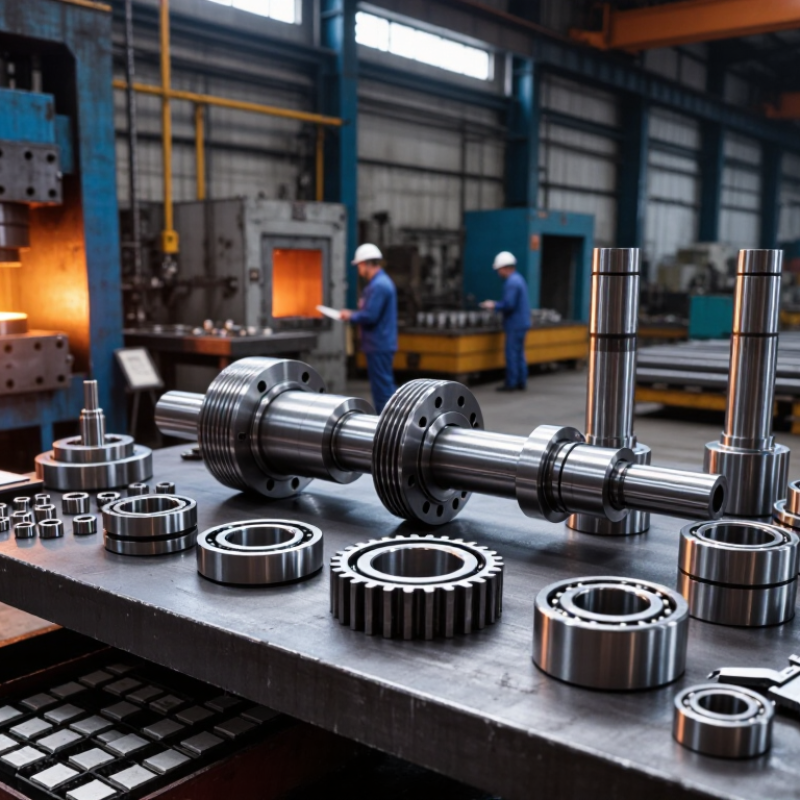
Alloy steel parts supplied worldwide range from heavy forged components to precision-machined pieces. Common products include shafts, gears, rings, flanges, pins, and fasteners. A transmission shaft may have stepped diameters and keyways that must align with mating parts. Gear blanks need sound material and accurate machining before teeth are cut. Small components matter too.

Valve stems, connecting rods, and bearing housings serve different loads and operating conditions. Their suitability depends on alloy composition, heat treatment, dimensions, and surface finish. Buyers can compare material certificates, inspection reports, and stated tolerances before approving a shipment. These records help, but paperwork alone cannot prove consistent production. A polished datasheet is not enough.

Some suppliers also provide cast housings, hydraulic fittings, and custom-forged parts. For rotating equipment, ask how straightness and hardness are checked; a small variation can affect assembly. Heat-treated parts may arrive with scale or slight discoloration, which is not automatically a defect. The acceptance criteria should be clear. I would still question vague claims such as “high precision” unless a drawing or measurement method backs them up.

Top Alloy Steel Parts Manufacturers for Global Buyers — Major Types of Alloy Steel Components Supplied Worldwide

Alloy steel components such as gears, shafts, fasteners, and drivetrain parts are made from grades selected for their required properties. This chart compares the midpoint chromium and molybdenum content of common grades; values are representative weight percentages, not production or sales data. Actual composition limits depend on the applicable specification.

Manufacturing Processes and Quality Standards

Reliable alloy steel parts begin with a clear drawing, material grade, and service conditions. Forging can refine the part’s shape and support strength, while casting suits more complex forms. CNC machining then brings critical surfaces and holes to specified dimensions. Each route has trade-offs.

Heat treatment must match the alloy and intended use. Controlled heating and cooling affect hardness, toughness, and wear resistance. Shops should record furnace temperatures and batch details. Inspection may include dimensional checks, hardness testing, and visual examination for cracks or surface defects. Small details matter. A prototype can still reveal distortion or machining issues that were not obvious on paper.

Quality requirements should be agreed before production. Buyers can specify applicable material and testing standards, acceptance limits, inspection frequency, and documentation in the purchase order. Ask for material test reports and traceability linking parts to their production batches. Requirements vary by application, so a standard alone does not guarantee fitness for use.

Tips: Confirm the grade and heat-treatment condition before approving samples. Check a few key dimensions on the first article. Keep records. If a measurement seems inconsistent, pause and review the method; even a sound process can produce an unclear result.

How to Evaluate Alloy Steel Parts Manufacturers

How to Evaluate Alloy Steel Parts Manufacturers

Evaluating an alloy steel parts manufacturer starts with evidence, not polished claims. The World Steel Association’s 2024 World Steel in Figures reports 1,892.2 million tonnes of crude steel production in 2023. That scale makes material traceability essential: ask for heat numbers linking each batch to its mill certificate.

Check whether reported chemistry matches the specified grade, and whether hardness or tensile tests reflect the finished part, not just raw stock. Small details matter. A missing heat number can complicate an otherwise capable supplier’s paperwork.

Next, review process control across forging, heat treatment, machining, and inspection. Request sample dimensional reports, calibration records, and documented acceptance criteria for critical features such as bore size or shaft runout. Ask how the supplier handles nonconforming parts and whether corrective actions are verified.

A certificate alone is not proof. An independent audit or trial order can reveal gaps that a presentation will not. Compare lead times against actual production capacity, too; a low quote may depend on optimistic scheduling.

Even strong systems can slip, so clarify who communicates changes and how quickly. No checklist removes every risk, but measurable records make comparison fairer.

Key Considerations for Global Buyers Sourcing Alloy Steel Parts

Global buyers should define the part’s working conditions before comparing alloy steel suppliers. The World Steel Association reported 1,882.6 million tonnes of crude steel production in 2024; that figure covers all steel, not alloy grades. It signals a vast supply base, but says little about a supplier’s ability to control a specific composition or heat treatment. Provide the required grade and governing standard, then state hardness, tensile strength, operating temperature, and service environment. A shaft exposed to shock loads needs different verification from a small, lightly loaded fitting. Details matter.

Ask for material test certificates linked to the actual production heat, not just a sample document. Confirm that chemistry and mechanical results match the purchase specification, and agree on inspection methods and acceptance limits before production. For critical dimensions, request measured reports; consider independent testing when the order or application warrants it. Heat treatment can change performance, so record the condition and verification method. A certificate alone is not proof that every part conforms. I would still inspect the first sample. Small gaps matter. Also specify corrosion protection, packaging, and transit handling: surface rust or mixed batches can complicate receiving checks. Clear requirements reduce disputes, though they cannot eliminate manufacturing variation.

Top Alloy Steel Parts Manufacturers for Global Buyers – Key Considerations for Global Buyers Sourcing Alloy Steel Parts

Evaluation Dimension What Global Buyers Should Check Useful Evidence or Data Buyer’s Acceptance Basis
Material grade and specification Confirm the exact alloy steel grade, governing standard, product form, and any customer-specific requirements before production. Purchase specification; material test certificate; grade and standard listed on the quote and order confirmation. All documents and supplied material match the approved drawing and purchase order. Standards such as ASTM, EN, and JIS are not automatically interchangeable.
Heat-number traceability Check whether raw material can be traced from the incoming stock through processing and final shipment. Heat or cast number; material certificate; batch records; part or packaging identification where required. Traceability records link the delivered batch to its material documentation and inspection records.
Mechanical properties Specify the required tensile strength, yield strength, elongation, impact properties, or hardness where relevant to the application. Test results from the material certificate or agreed product-testing plan. Results meet the limits stated in the applicable material standard, drawing, or purchase specification.
Heat treatment Define the required condition, such as annealed, normalized, quenched and tempered, or case hardened, where applicable. Heat-treatment procedure; batch records; hardness results; test location and method when specified. Condition and measured properties conform to the approved specification; hardness limits should be set for the part and application rather than assumed universally.
Dimensional capability Review critical dimensions, tolerances, datums, surface finish, and the measurement method for each controlled feature. Inspection plan; dimensional report; calibrated measurement-equipment records; first-article inspection when required. Measured results comply with the drawing and agreed sampling or inspection plan.
Defect and non-destructive testing controls Identify the relevant risks for the part, including surface cracks, internal discontinuities, or forging defects, and agree on inspection scope. Visual inspection records and, where specified, magnetic-particle, ultrasonic, or other suitable test reports. Methods, coverage, acceptance criteria, and reporting requirements are agreed before production; testing is applied where required by the part specification.
Manufacturing process fit Assess whether the supplier’s processes match the part design, volume, and required material condition—for example, forging, casting, machining, or fabrication. Process flow; tooling and capacity review; sample parts; process-control plan. Process route is approved, technically suitable, and consistent with the part’s design and quality requirements.
Quality management and corrective action Review the supplier’s quality system, document control, inspection responsibilities, and handling of nonconforming product. Current quality-system certificate, if applicable; audit findings; corrective-action records; inspection procedures. Certification scope and actual controls are relevant to the ordered work; certificates should be verified with their issuing bodies when needed.
Sample approval and production release Agree how prototypes, samples, or first articles will be reviewed before serial production or shipment. Approved sample record; first-article report; signed drawing revision; documented change-control process. Production starts against the current approved revision, and changes to material, process, or design are communicated and authorized.
Packaging, preservation, and shipping Specify protection against corrosion, impact, contamination, and handling damage during storage and international transport. Packaging specification; packing list; marking requirements; agreed shipping terms and dispatch documents. Packaging and shipment documentation meet the order requirements and destination-country rules applicable to the goods.
Total landed cost and delivery planning Compare the complete commercial offer rather than unit price alone, including tooling, inspection, packaging, freight, duties, and lead time. Itemized quotation; production and shipping schedule; stated trade term; payment and tooling terms. Costs, responsibilities, delivery milestones, and quotation validity are clear and comparable across offers.

Acceptance limits, inspection frequency, and required certifications vary by part design, application, contract, and destination market. Buyers should define these requirements in the drawing or purchase specification before placing an order.

100% Mercury Free

100% Mercury Free

All of Hapco's formulations are completely free of Mercury.

50 Year Track Record

50 Year Track Record

Hapco has been in business for over 50 years!

ISO Certified

Higher Quality. More Efficiency. View Certificate

Technical Expertise

Hapco's employees are knowledgeable and ready to help.

Join Our Mailing List

Get the latest news, updates, and articles from Hapco, Inc.

Join Now