Who Makes the Best Roller Table Conveyor in China?
When buyers ask who makes the best Roller Table Conveyor in China, the answer depends on the load, line layout, and service expectations. A compact unit handling cartons needs different rollers and drive control from a steel-frame conveyor carrying heavy components. The best supplier is not always the one with the lowest quotation. Details matter.
MHI’s 2024 Annual Industry Report found that 55% of respondents planned to increase supply-chain technology investment over the following three years. That broader trend makes conveyor selection more consequential: a poorly matched section can slow an otherwise automated line. Look closely at roller diameter, frame thickness, bearing quality, load capacity, and how smoothly a sample unit starts under load. Ask for drawings, test records, spare-parts lead times, and references from comparable installations. A factory visit can reveal practical details, such as weld consistency and how neatly cables are routed. Still, a polished sample cannot guarantee years of trouble-free operation. I would treat broad performance claims cautiously and verify them against operating conditions. A little doubt is useful. This guide compares Chinese manufacturers through product fit, engineering evidence, quality control, customization, and after-sales support, helping buyers judge which supplier best matches their actual conveyor application.
Roller Table Conveyor Basics: Gravity, Powered, and 24 V MDR Systems
Who Makes the Best Roller Table Conveyor in China?
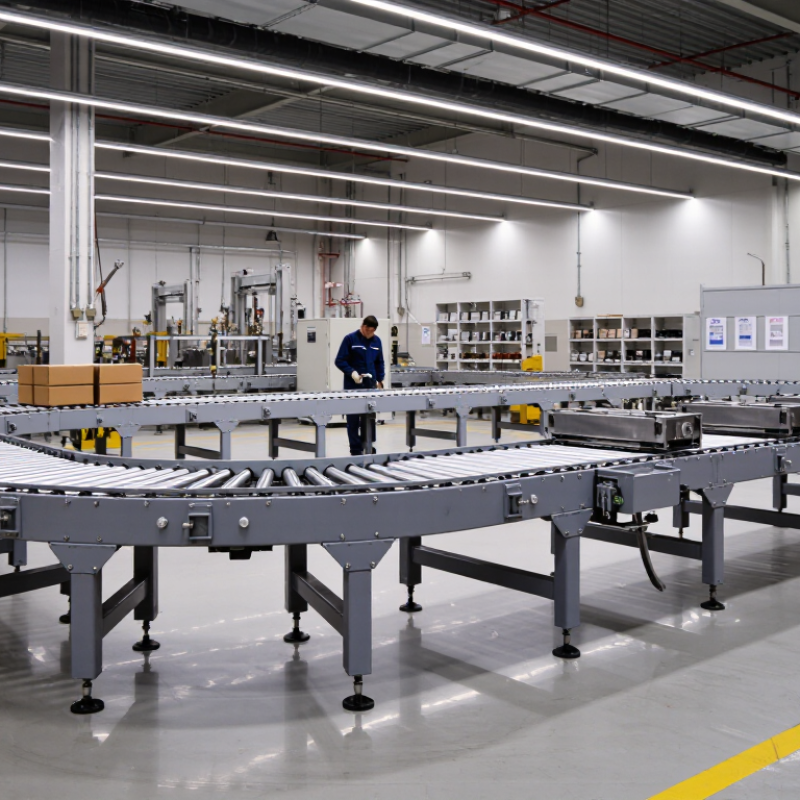
A roller table conveyor is not one fixed design. Gravity, powered, and 24 V MDR systems move loads in different ways. With gravity rollers, cartons travel down a slight incline, pushed by hand or by their own weight. Roller diameter, spacing, and frame level matter; an uneven floor can make cartons drift sideways. Simple, but not foolproof.
Powered roller conveyors use driven rollers or belts to move items at a controlled speed. They suit flat layouts, heavier loads, and lines where operators need predictable movement. A 24 V motor-driven roller, or MDR, system places compact motors within selected rollers. Zones can run only when needed, reducing unnecessary motion and noise. Still, closely spaced cartons, unusual bases, or poor sensor placement can cause jams. That detail is easy to overlook.
When comparing manufacturers in China, ask for load limits, roller spacing, speed range, and layout drawings for your actual products. Request a test with representative cartons, not just an empty conveyor. Check how the controls handle accumulation, and ask whether replacement rollers and wiring details are documented. “Best” depends on fit and support, not just a low quotation. I would also review maintenance access before approving the final design.
Who Makes the Best Roller Table Conveyor in China?
Roller Table Conveyor Basics: Gravity, Powered, and 24 V MDR Systems
Illustrative suitability ratings (1 = low, 5 = high), based on typical system characteristics—not measured performance or a market survey. Gravity conveyors need no drive power and suit simple transport; powered rollers support continuous movement; 24 V MDR systems are commonly used for controlled, zone-based accumulation. Actual suitability depends on the load, layout, controls, and operating requirements.
Chinese Supplier Landscape: Conveyor OEMs, Integrators, and Exporters
China’s roller table conveyor market includes OEMs, system integrators, and exporters. OEMs typically build standard rollers, frames, and drive sections. Integrators combine these parts with sensors, controls, and adjoining equipment. Exporters may manufacture products or coordinate production through partner factories. These roles can overlap, so a polished catalog does not always reveal who handles engineering or service.
Compare suppliers using your actual load, line speed, roller spacing, and operating environment. Ask for drawings, material specifications, motor details, and a clear scope of supply. A practical review should also cover installation support, spare-part availability, and packaging for shipment. Request a test video with a representative load, not just an unloaded conveyor. Details matter. A supplier may quote quickly but still need time to confirm unusual dimensions; that is worth clarifying, not automatically a warning sign.
Tips: Send a simple layout and product dimensions with your inquiry. Ask who is responsible for design changes and commissioning. Check sample documents carefully. A small mismatch in roller pitch can disrupt transfers later. Don’t choose on price alone.
Capacity Checks: 3-Roller Support, Rated Load, Speed, and Duty Cycle
Who makes the best roller table conveyor in China? The useful answer starts with a load test, not a polished frame. For a three-roller support, check the product’s contact points: a long pallet may rest on only two rollers at once. A 1,000 kg load could therefore place about 500 kg on each roller before impact or uneven loading. Adding a 1.3 planning factor gives roughly 650 kg per roller. This is an illustrative check, not a certified rating. CEMA’s Belt Conveyors for Bulk Materials, 7th edition, and ISO 5048 provide calculation guidance for belt-conveyor loads and operating conditions; neither replaces the conveyor maker’s rated-load documentation. Small details matter. Roller spacing does too.
Ask for rated load per roller and per conveyor section, then verify the frame, bearings, and joints against that figure. A speed of 10 metres per minute may suit steady pallet movement, but starts, stops, and accumulation can increase stress. Duty cycle matters. A line running eight hours daily differs from one cycling continuously across shifts. Request test results at the stated load, speed, and duty cycle, and check whether the rating assumes evenly distributed loads. A tidy spreadsheet can still miss a crooked pallet or a seized bearing. I would want those assumptions written down before comparing suppliers.
Safety Benchmarks: EN 619:2022 and ISO 12100 Risk Assessment
For a roller table conveyor made in China, safety should be judged by evidence, not by a catalogue claim. EN 619:2022 provides safety requirements for equipment and systems handling unit loads. ISO 12100 guides a systematic risk assessment and reduction process. Neither standard alone proves that a particular installation is safe.
A competent assessment starts with the real layout. Inspect roller-to-frame pinch points, transfer gaps, drive chains, and access near maintenance areas. Consider how operators load cartons, clear jams, and respond to unexpected restarts. Small gaps matter. Under ISO 12100, designers identify hazards, estimate and evaluate risks, then reduce them through safer design, guards, and clear instructions. Emergency stops and isolation points should be positioned for the actual work, not just shown on a drawing.
Ask the manufacturer for a risk assessment linked to the supplied configuration, plus guarding details, operating instructions, and relevant test records. Check that changes in roller spacing, speed, or adjoining machinery have been reviewed. A polished risk register can still miss an awkward hand movement during jam clearing. Site review matters. Strong suppliers explain remaining risks plainly and support inspection before commissioning.
Supplier Scorecard: Test Data, Compliance, Warranty, and Lifecycle Cost
Who Makes the Best Roller Table Conveyor in China?
A useful supplier scorecard starts with repeatable test data, not brochure claims. Ask for rated load, roller spacing, line speed, noise readings, and tracking results under your actual carton sizes. Request the test method and calibrated instrument records. For powered sections, check motor duty cycle and energy use; for gravity sections, test flow and stopping behavior. Small differences matter. MHI’s 2024 Annual Industry Report found that 55% of surveyed professionals planned to increase supply-chain technology investment. That makes measurable performance more valuable than a low purchase price alone.
Check compliance documents against the equipment’s intended use, including risk assessment and relevant conveyor standards. Verify that drawings, guarding details, and operating instructions match the delivered unit. Warranty review needs equal care: compare coverage periods, wear-part exclusions, response times, and who pays for replacement freight. Then estimate lifecycle cost across installation, spare rollers, labor, energy where applicable, and downtime. The U.S. Department of Energy’s Operations & Maintenance Best Practices Guide emphasizes that maintenance planning affects equipment reliability and operating costs. Use its principles, but adapt them to your site. No scorecard is perfect. A spreadsheet may miss a rough floor, awkward access, or cartons that behave differently during a busy shift. Include a witnessed acceptance test before final approval.