
Skip to Content

Liquid Molding Monthly

China Top 10 Exhaust End Pipe Manufacturers in 2026

A small component can shape a vehicle’s final impression. The Exhaust End Pipe frames the rear bumper, channels exhaust flow, and faces heat, moisture, road salt, and vibration. Its finish may catch a buyer’s eye. Its welds, dimensions, and corrosion resistance matter longer. For manufacturers, consistency across materials and vehicle fitments is as important as appearance.

The market operates within a changing vehicle landscape. OICA reported 92.5 million motor vehicles produced worldwide in 2024, a broad indicator of the scale of automotive component demand. The International Energy Agency’s Global EV Outlook 2025 reported that electric-car sales were expected to exceed 20 million that year, showing why suppliers must account for changing powertrain mixes. These figures do not measure end-pipe sales directly. They do, however, offer useful context for evaluating suppliers’ production reach and adaptability.

A design principle often attributed to automotive engineer Colin Chapman says, “Adding power makes you faster on the straights. Subtracting weight makes you faster everywhere.” Chapman was speaking about vehicle design broadly, not specifically exhaust outlets. Still, the principle reminds buyers to weigh performance and material choices alongside styling. This 2026 guide compares ten China-based manufacturers by product range, fabrication capability, finish options, and export experience. Treat rankings as a starting point, not a substitute for checking samples, specifications, and quality records. Details can disappoint. A bright tip alone proves little.
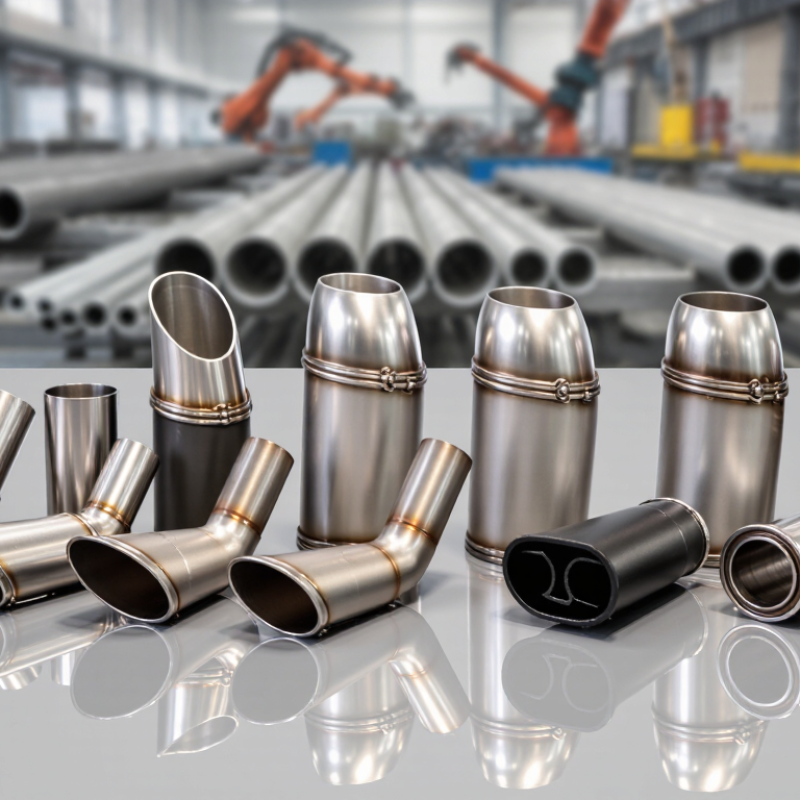
China Top 10 Exhaust End Pipe Manufacturers in 2026

What Exhaust End Pipes Are and How They Fit Into Vehicle Exhaust Systems

An exhaust end pipe is the final section where gases leave a vehicle’s exhaust system. It usually sits after the muffler, though designs vary. Upstream components route exhaust gases, reduce noise, and, where fitted, control emissions. The end pipe mainly provides a clear outlet and protects the surrounding area from hot gases. Some vehicles use a shaped or polished tip, but appearance alone says little about the system’s condition.

Fit matters. Pipe diameter, outlet angle, length, and bumper clearance affect installation and heat exposure. A poorly matched pipe can rattle against the body or direct hot exhaust toward nearby trim.

OICA’s 2024 production statistics report about 92.5 million motor vehicles produced worldwide. That scale reflects a wide range of vehicle layouts—not one universal end-pipe specification. OICA data describes production, not replacement demand, so it should not be read as an exhaust-parts market estimate.

Tips: Measure the existing outlet and check clearance when the exhaust is cold. Compare connection type and dimensions before ordering. A larger-looking tip does not necessarily improve performance; the actual effect depends on the full exhaust design. Small details matter.


How China’s Exhaust End Pipe Manufacturing Industry Is Structured in 2026

China’s exhaust end pipe industry is not a single factory tier. It combines vehicle manufacturers’ procurement teams, large exhaust-system integrators, specialist metal-forming workshops, and aftermarket suppliers. China Association of Automobile Manufacturers data recorded 31.28 million vehicles produced in 2024. That scale supports broad demand, but end pipes remain a specification-driven component rather than a standalone market.

In practice, suppliers may cut stainless-steel or aluminized-steel tube, bend it to fit, weld joints, and finish visible surfaces. Larger integrators coordinate dimensions and assembly with vehicle makers; smaller specialists often focus on forming, polishing, or short production runs. CAAM’s 2024 figures also reported 5.86 million vehicle exports, indicating why some suppliers serve overseas programs. These figures describe vehicle output, not end-pipe sales—a distinction worth keeping clear. The industry map is not perfectly clean: capability and quality can vary between workshops.

Tips: Ask for material certificates, dimensional checks, and sample inspection records. Compare weld consistency and finish under direct light. A low quote may omit tooling or testing costs.

China Top 10 Exhaust End Pipe Manufacturers in 2026 - How China’s Exhaust End Pipe Manufacturing Industry Is Structured in 2026
Industry Dimension Typical Products or Materials Common Manufacturing Activities Key Buyer or Quality Considerations
1. Product scope Exhaust tips, tailpipe extensions, decorative outlets, and shaped end sections Tube cutting, end forming, flaring, bending, and edge finishing Dimensions, outlet shape, wall thickness, and compatibility with the intended exhaust system
2. Stainless steel options Common exhaust-grade ferritic stainless steel, such as 409, and corrosion-resistant austenitic stainless steel, such as 304 Sheet or tube processing, forming, joining, and surface finishing Grade selection balances corrosion resistance, temperature exposure, appearance, and cost
3. Other metal options Aluminized steel and carbon steel, depending on product specification and application Cutting, rolling, stamping, welding, and protective finishing where specified Coating condition, corrosion exposure, intended service life, and total installed cost
4. Forming and fabrication Straight, angled, rolled-edge, dual-outlet, and other formed end-pipe designs Press forming, tube expansion or reduction, mandrel or rotary bending, and welding Repeatable geometry, clean edges, joint strength, and consistency between production batches
5. Joining methods Welded assemblies and clamp-on or slip-fit components, according to design TIG or MIG welding, fixture-based assembly, and post-weld cleaning Joint integrity, alignment, leak risk, and suitability for the installation method
6. Surface treatment Polished, brushed, coated, or otherwise finished metal surfaces Grinding, polishing, passivation where applicable, and coating or plating when specified Finish uniformity, adhesion, corrosion performance, and resistance to heat and road exposure
7. Fitment and customization Vehicle-specific replacement parts and made-to-specification outlet components Drawing review, sample approval, tooling setup, and dimensional inspection Inlet diameter, outlet projection, clearance, mounting arrangement, and approved drawings
8. Quality control Incoming metal, formed parts, weldments, and finished exhaust end pipes Material verification, dimensional checks, visual inspection, and process-based weld checks Traceable material specifications, documented inspection criteria, and consistent workmanship
9. Production and sourcing model Standard catalog items, private-label supply, and made-to-order components In-house fabrication combined, where needed, with external metal, finishing, or packaging suppliers Supplier control, capacity planning, lead-time clarity, and change management
10. Sales channels and compliance Domestic aftermarket supply, export orders, and components supplied for vehicle or exhaust-system programs Order specification review, export packing, documentation, and customer-specific approval processes Destination-market requirements, product claims, packaging protection, and applicable vehicle noise or emissions rules

Note: This table describes common product and manufacturing dimensions, not a verified ranking of individual manufacturers. Company names, brand data, and unsupported market-share estimates are intentionally omitted.

Criteria for Selecting and Ranking China’s Top 10 Manufacturers

Ranking China’s exhaust end pipe manufacturers in 2026 takes more than comparing catalog photos or quoted prices. Start with product fit: inlet diameter, outlet length, wall thickness, bend angle, and mounting method. Fit comes first. A sample should align with the target pipe without force, and its edges and welds should remain even after handling.

Material and process evidence matter. Request material records, coating details, corrosion-test conditions, and dimensional inspection results. Check whether these records match the production batch being evaluated. A polished finish helps, but it cannot prove durability alone. Inspect cut edges, weld continuity, and surface consistency under ordinary workshop lighting. Review production capacity, lead times, packaging, and how rejected parts are handled. Small details matter.

For a fair ranking, give verified quality and repeatability more weight than a low initial price. Also assess communication, customization, and delivery performance. Compare matching specifications, and request samples from separate production runs when possible. No score is perfect. A factory visit may reveal habits a spreadsheet misses, but one visit is only a snapshot. State the criteria and evidence behind each score, and identify information gaps. This makes the ranking useful, not absolute.

China Top 10 Exhaust End Pipe Manufacturers in 2026

Criteria for Selecting and Ranking Manufacturers

These proposed weights form a transparent evaluation framework, not measured results or rankings of specific companies. Assess manufacturers against each criterion using verifiable product, factory, compliance, and service documentation.

Profiles of China’s Top 10 Exhaust End Pipe Manufacturers in 2026

Profiles of China’s Top 10 Exhaust End Pipe Manufacturers in 2026 offer a practical way to compare production strengths, rather than relying on broad claims. Some manufacturers focus on stainless-steel tips with rolled edges and mirror polishing. Others handle custom diameters, wall thicknesses, and outlet shapes for different vehicle programs. Details matter. A clean weld inside the pipe can be as important as a bright exterior finish.

The profiles also consider manufacturing processes, sample support, and quality checks. Look for clear measurements, consistent surface treatment, and inspection records for dimensions and welds. Several suppliers may offer similar shapes, yet differ in tooling flexibility or their ability to manage small trial orders.

Ask how they control discoloration after welding. It is an easy detail to overlook. The profiles are best read as a comparison of stated capabilities, not a guaranteed ranking: buyers should confirm current equipment, material specifications, lead times, and sample quality directly.

Even a well-polished sample may not reflect every production batch. That is worth remembering.

How to Compare Manufacturers by Products, Capacity, Quality, and Export Services

Compare exhaust end pipe manufacturers by the parts they actually make, not catalogue breadth alone. Check diameters, wall thicknesses, outlet shapes, finishes, and whether custom dimensions require new tooling. A sample should fit the intended vehicle and sit evenly at its mounting points. Ask for material specifications and inspection records; a polished surface proves little by itself. Small details matter.

Capacity is more than a monthly production figure. Ask how many lines are available, what lead times look like during peak periods, and whether sample orders follow the same process as larger runs. Quality checks should cover dimensions, weld consistency, and finish, with clear records for rejected parts. Export service deserves equal scrutiny: confirm packaging, shipment coordination, document preparation, and response times before placing an order. Paperwork can vary. A high capacity claim may sound reassuring, but it is hard to judge without recent delivery examples. Compare evidence, not promises, and leave room for uncertainty when factory data is incomplete.

100% Mercury Free

100% Mercury Free

All of Hapco's formulations are completely free of Mercury.

50 Year Track Record

50 Year Track Record

Hapco has been in business for over 50 years!

ISO Certified

Higher Quality. More Efficiency. View Certificate

Technical Expertise

Hapco's employees are knowledgeable and ready to help.

Join Our Mailing List

Get the latest news, updates, and articles from Hapco, Inc.

Join Now