How to Choose Barite Drywall Radiation Shielding in 2026?
Choosing Barite Drywall Radiation Shielding in 2026 requires more than comparing product prices or advertised lead thickness. Radiation protection depends on the source, workload, distance, room layout, and required design goal. A diagnostic X-ray room does not need the same solution as a CT suite or dental imaging room. Small differences matter.
Dr. Christopher Clement, former Scientific Secretary of the International Commission on Radiological Protection, states, “The aim of radiological protection is to protect people and the environment from harmful effects of ionising radiation.” That principle should guide every material decision. Barite drywall may offer practical installation, consistent thickness, and cleaner construction than loose shielding materials. However, its performance depends on density, panel composition, joints, fasteners, corners, doors, ceilings, and service penetrations.
Details matter most.
This guide will examine how to select Barite Drywall Radiation Shielding for modern healthcare and industrial spaces. It will compare shielding requirements, verified product data, installation methods, fire performance, moisture resistance, and long-term maintenance. Readers should request independent test documentation and consult a qualified medical physicist before ordering. Manufacturer claims are useful, but they are not a complete shielding design.
There is no perfect shortcut. A heavier panel may reduce installation space, yet create structural challenges. A cheaper system may appear efficient, but weak joints can undermine the entire barrier. Even experienced teams can overlook cable openings or poorly sealed seams. Therefore, this 2026 guide focuses on practical evidence, careful planning, and honest limitations rather than exaggerated promises.
Assess the Radiation Source, Room Use, and Shielding Requirements
How to Choose Barite Drywall Radiation Shielding in 2026?
Assess the radiation source before choosing barite drywall. Diagnostic X-ray systems commonly operate between about 40 and 150 kVp, but CT, fluoroscopy, and dental units create different exposure patterns. NCRP Report No. 147 recommends evaluating workload, use factor, occupancy, and distance. These variables matter more than wall thickness alone. A busy fluoroscopy room may need stronger shielding than a low-use dental room.
Room use changes the design. Mark the control booth, patient areas, corridors, and rooms above or below the installation. IAEA Safety Reports Series No. 47 recommends assessing both primary and scattered radiation paths. A wall facing the X-ray tube usually needs more protection than a side partition. Barite drywall can provide useful mass, but its density and installed thickness must match the approved calculation. Check laboratory test data, joints, outlets, doors, and service penetrations. Small gaps can weaken an otherwise solid barrier.
Use NIST XCOM attenuation data or a qualified physicist’s calculation to compare material performance across photon energies. Do not copy a thickness from another clinic. It may be wrong. For radiotherapy or higher-energy sources, ordinary barite drywall may be unsuitable without additional engineering. Local regulations and a radiation protection survey should verify the finished room. One detail is often missed: future equipment upgrades can increase workload, leaving today’s design too weak.
Compare Barite Drywall Types, Thicknesses, and Shielding Performance
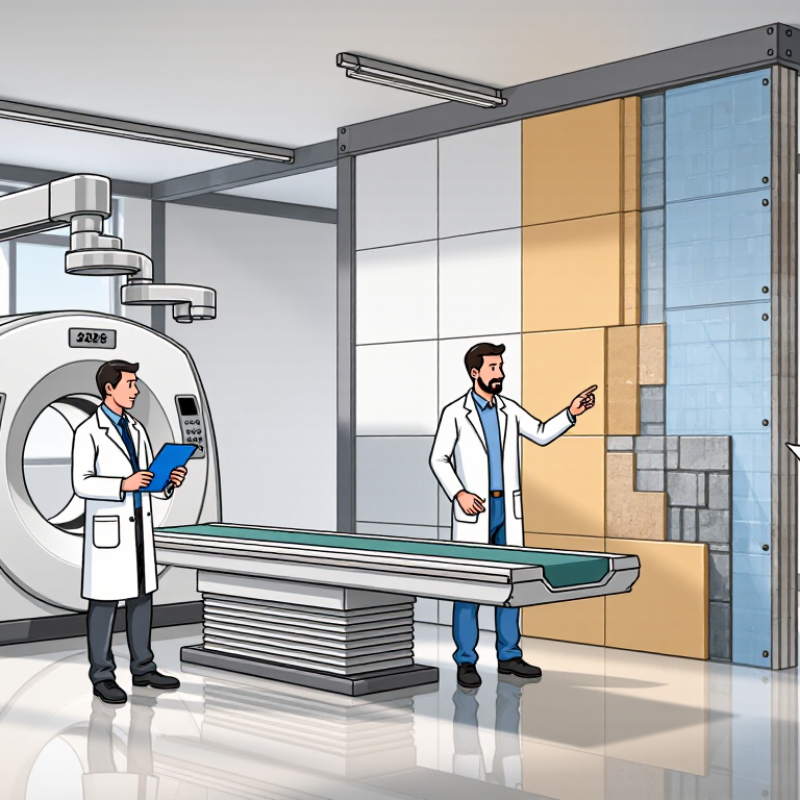
Choosing barite drywall in 2026 requires more than selecting the thickest panel. Barite drywall combines gypsum with barium sulfate, creating a dense barrier for diagnostic X-ray areas. Common options include standard panels, high-density panels, and layered wall systems. Their performance changes with thickness, panel density, and radiation energy.
A 12.5 mm panel may suit limited exposure conditions, while 15 mm or 19 mm panels can provide greater attenuation. However, thickness alone does not determine protection. A thinner, denser board may outperform a thicker, poorly installed panel.
Review tested shielding values at the planned kVp range, not only general product claims. Ask a qualified radiation physicist to calculate workload, occupancy, distance, and wall layout.
Installation details matter greatly. Stagger board joints, seal penetrations, and protect outlets, corners, doors, and ceiling connections. One small gap can weaken an otherwise careful barrier. That detail is often missed.
Barite drywall can reduce structural weight compared with some masonry solutions, but it still needs proper framing support. Confirm screw spacing and handling requirements before installation. I would not treat a thickness chart as a complete design. Real rooms contain equipment movement, cable openings, and uneven workmanship. Site verification and documented test data make the choice more dependable.
Check Product Quality, Safety Standards, and 2026 Compliance Needs
Choosing barite drywall in 2026 requires more than comparing prices. Check panel density, thickness, dimensions, and edge condition before delivery. Uneven density can create weak shielding zones around seams. Ask for recent laboratory reports showing measured density and attenuation performance. The report should identify tested thickness and radiation energy ranges. A generic certificate is not enough. Paperwork matters.
Safety verification should cover applicable radiation-protection, building, fire, and workplace requirements in your jurisdiction. Requirements may differ by room function, equipment type, and healthcare authority. Have a qualified radiation physicist review the shielding calculation before installation. Inspectors may request drawings, batch records, safety data, and product declarations. Confirm that additives, binders, and surface layers suit indoor use. Do not assume a heavier panel is automatically safer.
For 2026 projects, request traceable batch numbers, updated technical files, and evidence matching current standards. Keep delivery photos, moisture checks, fastener details, and sealed penetration records. A small cable opening can undermine a carefully calculated wall. Installers should stagger joints and follow approved fixing distances. Seal gaps with compatible materials. Mistakes happen. Review them openly. If a supplier cannot explain testing limits or installation tolerances, seek independent technical advice before purchase. Compliance is a chain of evidence from factory to inspection.
Plan Wall Design, Joint Treatment, Installation, and Structural Support
How to Choose Barite Drywall Radiation Shielding in 2026?
A reliable wall design starts with the room’s radiation workload, equipment energy, occupancy, and adjacent spaces. Do not select thickness from a general table alone. A qualified medical physicist should calculate the required lead-equivalent performance and review local building requirements. Barite drywall adds substantial weight, so the wall frame, floor, fasteners, and ceiling connection need proper structural checks. A small oversight can become an expensive correction.
Joint treatment deserves equal attention. Stagger panel joints between layers, keep seams tight, and use compatible radiation-shielding compound where specified. Seal gaps around doors, sockets, conduits, ventilation, and service openings. These weak points often receive less attention during rushed installation. Panels should be cut accurately, lifted safely, and fixed according to the approved drawings. Avoid unnecessary penetrations. They complicate quality control.
Tips: Mark every penetration before installation. Photograph concealed layers. Check the subfloor capacity early. Ask the physicist to inspect critical joints before closing the wall. Field conditions may differ from drawings, and that is where judgment matters. I would also allow time for rework; perfect alignment is not always achieved on the first attempt. After installation, document material certificates, panel locations, joint details, and inspection results. A final radiation survey can reveal problems that visual checks miss. Never treat it as optional.