How to Choose Clear Epoxy Resin for Your Projects?
Choosing the right Clear Epoxy Resin can significantly impact your project's success. Expert Joe Miller, a renowned resin specialist, once said, "The choice of epoxy can make or break your design." This highlights the importance of understanding what makes a quality product.
When selecting Clear Epoxy Resin, various factors come into play. You need to consider clarity, viscosity, and curing time. High-quality resins offer excellent transparency and minimal bubbles. However, not all products deliver these qualities. It's crucial to research brands and read reviews from other users. Look for resins that are easy to mix and have a user-friendly application process.
As you navigate through different options, reflect on your specific project needs. Some epoxies perform better in certain environments. Awareness of these differences can prevent mistakes. No resin is perfect; each has its strengths and weaknesses. A thoughtful approach will lead you to the best Clear Epoxy Resin for your project.

Understanding the Different Types of Clear Epoxy Resin Available
When choosing clear epoxy resin, it's essential to understand the various types available. Each type has specific properties that suit different projects. For instance, some resins cure harder and more quickly, while others offer flexibility or enhanced UV resistance. Knowing these differences helps in making an informed decision.
One key type is the casting resin. This is ideal for deep pours, often used in art pieces or tabletops. However, it requires careful temperature control. Overheating can lead to issues like bubbling. Another type is the laminating resin. This offers a thinner consistency and is great for coatings. It may not be suitable for thick pours but provides a durable finish.
**Tips:** Always check the curing time on the packaging. Longer curing times can allow for better bubble dispersal. Experiment with small batches first to avoid waste. Remember, some resins may amber over time, affecting your project's aesthetics. Understanding these nuances can prevent pitfalls in your epoxy adventures.
How to Choose Clear Epoxy Resin for Your Projects?
| Type of Clear Epoxy Resin |
Best Use |
Curing Time |
Viscosity |
UV Resistance |
| Standard Clear Epoxy |
General purpose casting and coating |
24-48 hours |
Medium |
Low |
| Marine Epoxy |
Boat building and repair |
48-72 hours |
High |
High |
| Fast Cure Epoxy |
Quick repairs and small projects |
1-2 hours |
Low |
Medium |
| Crystal Clear Epoxy |
Art projects and jewelry making |
24-72 hours |
High |
Medium |
| Flexible Epoxy |
Applications requiring elasticity |
24-48 hours |
Medium |
Low |
Key Factors to Consider When Choosing Clear Epoxy Resin
When selecting clear epoxy resin for your projects, there are several critical factors to consider.
Clarity is essential. A high-quality resin should be
crystal clear, allowing for beautiful finishes. Consider the UV resistance
of the product. Some resins may yellow over time when exposed to sunlight, compromising your work’s appearance.
Next, pay attention to the viscosity of the resin. A thicker resin can be more challenging to work with,
but it offers better self-leveling properties. Test different types to see which one suits your techniques best.
The curing time is another vital element. Some resins cure quickly, while others take longer.
Choose based on your project's needs and your working pace.
Don’t overlook the safety aspects. Proper ventilation is crucial when working with epoxy resins. Use PPE to protect
yourself from fumes. Sometimes, even minor mistakes can lead to undesirable results. It’s okay to experiment and learn from these instances. Each
project teaches something valuable. Consider these factors carefully to enhance your experience and outcome.
Evaluating the Performance Characteristics of Clear Epoxy Resin
When choosing clear epoxy resin for your projects, understanding its performance characteristics is essential. Clear epoxy resin typically offers high clarity, making it perfect for crafting and artistic applications. Pay attention to the viscosity as this impacts the flow and ease of application. High-viscosity resins are thicker and may take longer to cure but can provide a thicker layer. Conversely, low-viscosity resins are easier to pour into intricate molds or spread over surfaces.
Moreover, the curing time can affect your project significantly. Fast-curing epoxy may seem appealing, but it often sacrifices workability. Extended curing times allow more manipulation but may not suit all projects. It’s essential to consider the environment too. Temperature and humidity levels can alter drying times and bonding strength. Test small batches first to gather data on how the resin performs in your conditions.
The clarity of the epoxy is critical for aesthetic purposes. However, even the clearest resin may develop bubbles during mixing. These can be a nuisance and detract from the final look. Degassing techniques, like using a vacuum chamber, can minimize this issue but may not be feasible for everyone. Thus, be prepared to experiment and adjust your approach, as mastering epoxy can require time and practice.
Identifying Suitable Applications for Clear Epoxy Resin
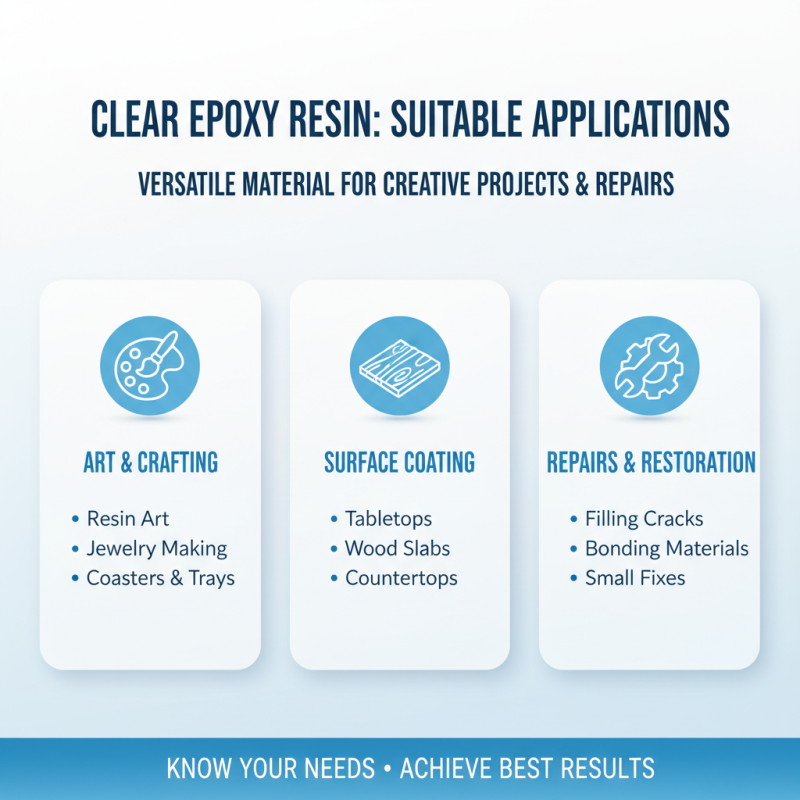
Clear epoxy resin is a versatile material used in various projects. Understanding suitable applications is crucial for achieving the best results. This resin works effectively in art, crafting, and repairs. Whether you are covering wooden surfaces or creating resin art, know your needs first.
For artistic projects, consider the clarity and UV stability of the epoxy. Some resins may yellow over time. Ensure that the epoxy you choose is ideal for color retention. When using it for furniture, structural integrity matters. A strong bond will prolong the life of your pieces. Testing on small sections can help identify compatibility with different materials.
In a repair context, the application method can vary. Mixing ratios are essential. Improper proportions may lead to a brittle finish. If bubbles appear during curing, you might need to rethink your approach. Environment also plays a role. Temperature and humidity affect curing times significantly. Always work in a controlled setting for the best outcome.
Tips for Proper Mixing and Application of Clear Epoxy Resin
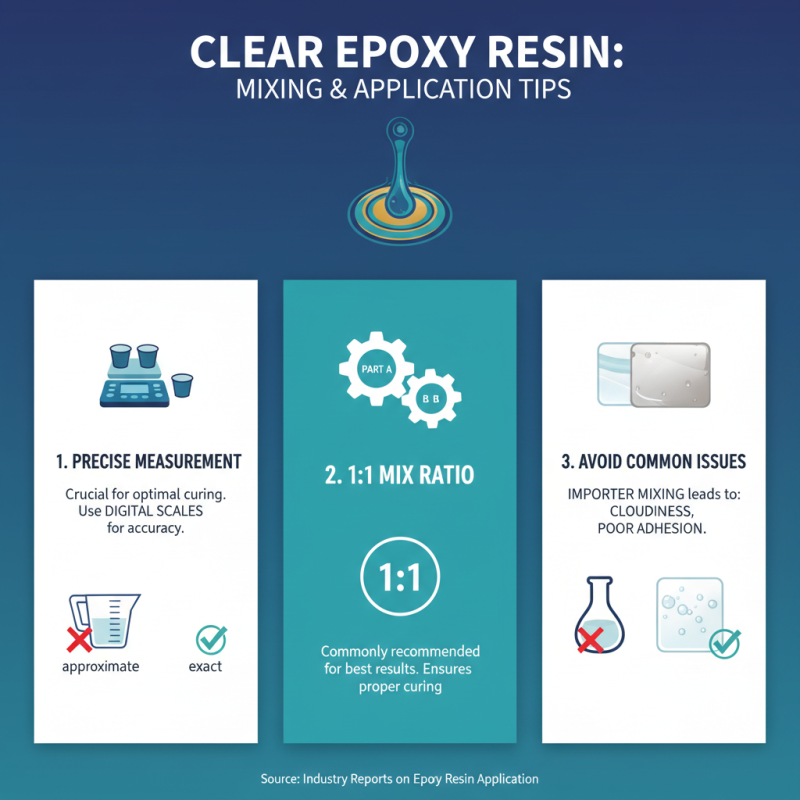
When working with clear epoxy resin, proper mixing and application are crucial for achieving the best results. According to industry reports, improper mixing can lead to issues such as cloudiness or poor adhesion. Ensure a 1:1 mix ratio, as this is often recommended for optimal curing. Measuring precisely is key. Use digital scales for accuracy.
Mix slowly to avoid air bubbles. Stirring too quickly introduces unwanted air, which compromises the finish. It's best to use a flat-bottom container for mixing. This helps in achieving a uniform consistency. In many cases, a thorough mix of 3-5 minutes is ideal. Consider using a heat gun to pop any surface bubbles after pouring.
Temperature can greatly affect the curing process. Many professionals suggest maintaining a room temperature between 70°F and 85°F for optimal results. Cooler temperatures can slow the curing time, while high heat may lead to rapid curing, causing cracks. Always check the manufacturer's guidelines for specific recommendations. Small adjustments can make a significant difference in your project outcome. Learning from mistakes in previous projects will enhance your technique over time.