How to Choose High Performance Polymers for Your Projects?
Choosing the right materials can make or break a project. The decision becomes even more critical when it comes to High Performance Polymers. These materials offer unique properties like resistance to heat and chemicals, making them ideal for various applications.
Dr. Emily Zhang, a leading expert in polymer technology, states, “Selecting the appropriate High Performance Polymers can significantly enhance your project’s efficiency.” This insight highlights the importance of understanding your specific needs. Different projects require different polymer characteristics.
Many industries rely on High Performance Polymers for their durability and performance. For instance, aerospace and automotive sectors need materials that can withstand extreme conditions. Yet, the selection process can be overwhelming. Many factors must be considered, including cost and availability. Mistakes can lead to project delays or failures. Thoughtful evaluation is essential for success.

Understanding High Performance Polymers: Definition and Characteristics
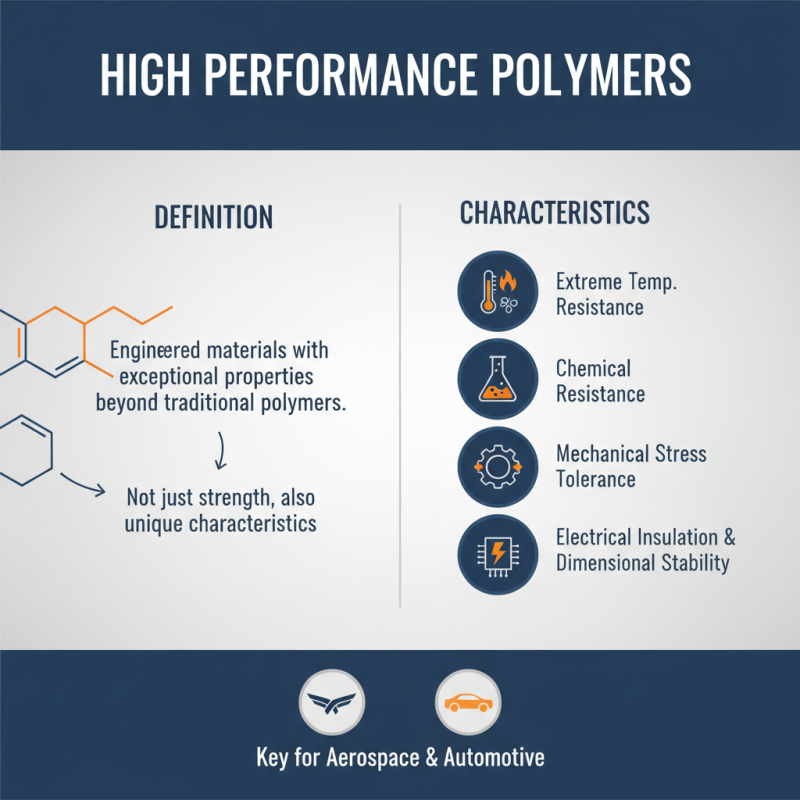
High performance polymers are essential for various industrial applications. Their definition is not merely about strength but also their unique characteristics. These polymers are engineered to withstand extreme temperatures, chemicals, and mechanical stresses. They often provide excellent electrical insulation and dimensional stability, key features for aerospace and automotive industries.
One important characteristic is their thermal stability. Many high-performance polymers can endure temperatures well above standard plastics. For instance, some can perform efficiently at temperatures exceeding 260°C. Additionally, their chemical resistance makes them ideal for environments where exposure to corrosive substances is common.
However, selecting the right polymer can be challenging. Not every polymer suits every application. It’s crucial to analyze specific project needs. Factors such as cost, weight, and processing methods play vital roles. Remember, not all high-performance polymers will deliver the expected results in every scenario. Testing and real-world evaluation can help validate choices.
Key Factors to Consider in Selecting High Performance Polymers
Choosing high-performance polymers requires careful deliberation. Understanding your project’s unique requirements is essential. Factors like chemical resistance, temperature tolerance, and mechanical strength play a crucial role in material selection. Assess how these properties align with your application needs to ensure optimal performance.
Tips: Consider the environment where the polymer will be used. Will it face extreme temperatures? Is it exposed to harsh chemicals? These elements impact long-term durability. Testing various samples under real conditions can reveal insights into their performance.
Another factor is cost-effectiveness. While high-performance polymers offer superior traits, their price can vary greatly. Evaluate your budget alongside the expected lifespan and performance benefits. Sometimes, a less expensive option may suffice for specific applications.
Tips: Engage with experts in materials science. Their insights can help avoid costly mistakes. Do not overlook the importance of supplier reliability. A reputable supplier ensures the quality and consistency of your chosen polymer, which is vital for project success.
Applications of High Performance Polymers Across Various Industries
High performance polymers are essential in many industries today. These materials excel in extreme conditions—high temperatures, corrosive environments, or mechanical stress. Applications span aerospace, automotive, medical, and electronics sectors. For instance, in aerospace, polymers provide lightweight solutions without sacrificing strength. They help reduce fuel consumption and improve overall efficiency.
In the automotive industry, these polymers contribute to long-lasting components. They enhance performance in fuel systems and electrical enclosures. In medical applications, they are critical for implantable devices and sterile packaging. However, not every polymer suits every application. Factors like temperature resistance, chemical compatibility, and mechanical properties must be carefully evaluated.
Certain challenges accompany the use of high performance polymers. Manufacturing processes can be complex and costly. Further, selecting the right polymer often requires trial and error. Engineers must consider the entire lifecycle of the product—how it will perform in real-world conditions. This iterative process ensures that the chosen material meets the specific needs of the project, balancing performance and cost-effectiveness.
High Performance Polymers Applications Across Industries
Comparative Analysis: High Performance Polymers vs. Traditional Materials
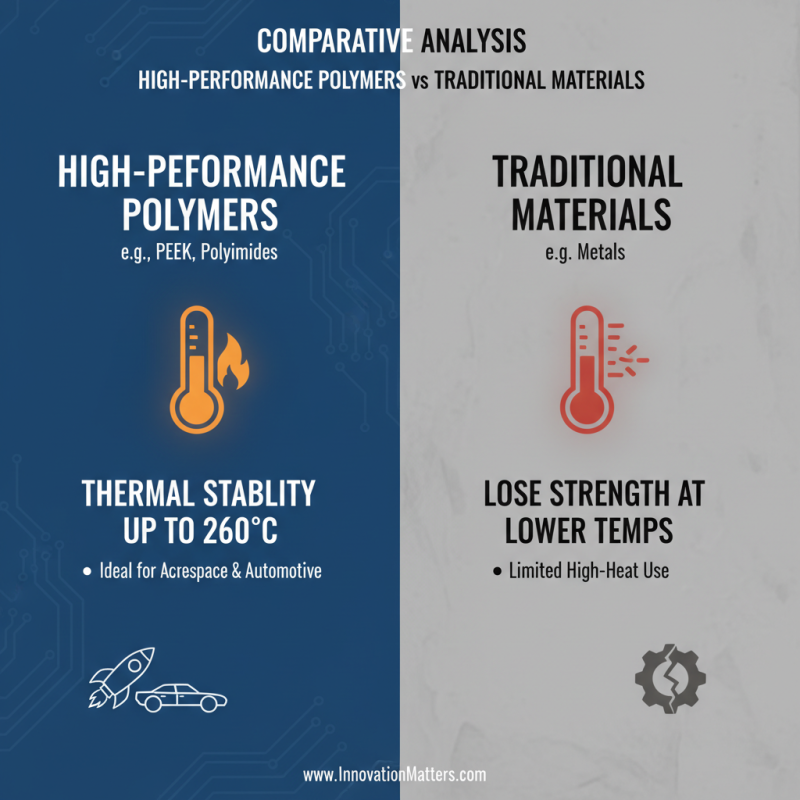
When comparing high performance polymers to traditional materials, several key factors come into play. High performance polymers, like polyetheretherketone (PEEK) and polyimides, showcase remarkable thermal stability. They can operate at temperatures up to 260°C, while traditional materials such as metals lose structural integrity at lower temperatures. This makes polymers ideal for aerospace and automotive applications where heat resistance is critical.
Moreover, high performance polymers often exhibit superior chemical resistance. A recent study highlighted that these materials can withstand harsh solvents and corrosive substances for extended periods. In contrast, traditional materials may degrade when exposed to similar environments. This leads to longer service life and reduced maintenance costs, crucial for sectors like pharmaceuticals and food processing.
One must also consider weight efficiency. High performance polymers are significantly lighter than metals, reducing overall project weight. Yet, they may come with higher initial costs. The return on investment can be substantial in specific applications, but it requires careful project assessment. Choosing the right material is crucial. Balancing performance against cost and application needs is a complex decision that may not always yield clear outcomes.
Sourcing and Testing: Ensuring Quality in High Performance Polymers
Sourcing and testing high-performance polymers is crucial for project success. Quality materials play a vital role in applications across numerous industries. According to a report from Grand View Research, the global high-performance polymer market is expected to reach $28 billion by 2028. This illustrates the growing demand for reliable materials.
When sourcing polymers, consider factors such as thermal stability, chemical resistance, and mechanical properties. A detailed material data sheet is invaluable. It provides insights into performance under specific conditions. Always ask suppliers for certifications to ensure compliance with industry standards, such as ASTM or ISO.
Tips for effective polymer testing include using standard methodologies like ASTM D638 for tensile properties. For thermal properties, Differential Scanning Calorimetry (DSC) is advisable. Ensure results are reproducible and consistent. Remember, testing small samples can lead to misleading conclusions. Always conduct tests on representative specimens.
In the world of high-performance polymers, reliability is not just a goal; it’s essential. Inadequate testing can result in unexpected failures. Emphasizing quality at every step is crucial for durability and performance.