How to Choose the Right Extruded Aluminum Profiles?
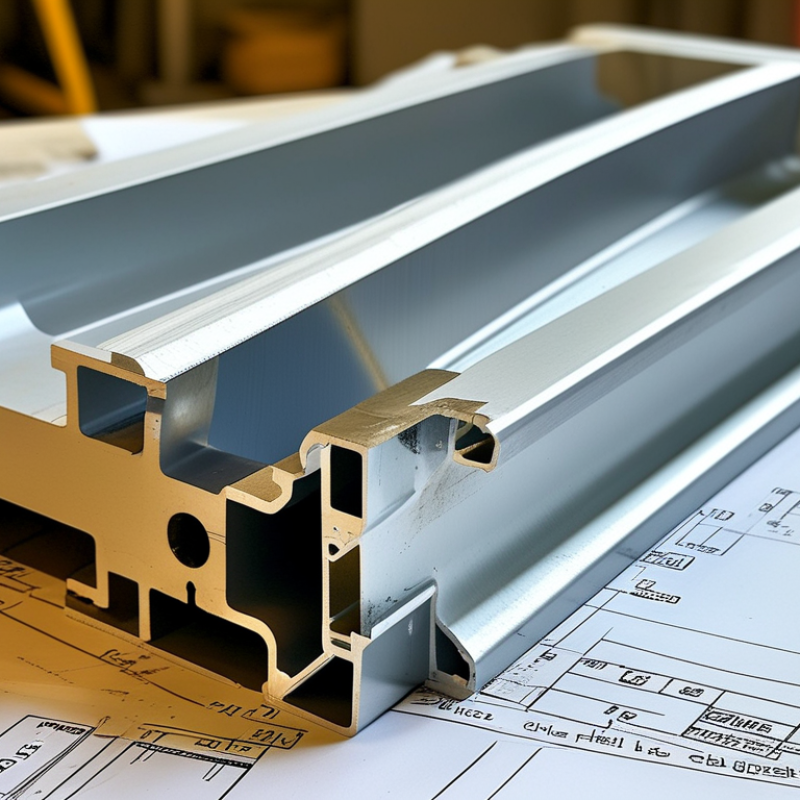
Choosing the right Extruded Aluminum Profiles is rarely a simple matter of selecting a shape from a catalogue. The profile must fit the load, span, environment, joining method, and production budget. A narrow channel may look elegant on paper, yet twist under a real door frame or machine guard. Wall thickness matters. So do the alloy, temper, tolerance, and surface finish.
Dr. S. K. Das, a recognized researcher and author in aluminum extrusion technology, describes the process this way: “Extrusion is not simply a shape-making process; it is a controlled relationship between material, tooling, and process.” That relationship deserves careful attention. A 6063 profile may provide an attractive finish and smooth extrusion, while 6061 may better support demanding structural applications. Neither choice is automatically correct. The answer depends on evidence.
This guide examines the decisions behind reliable Extruded Aluminum Profiles, from profile geometry and die design to strength, corrosion resistance, machining, and installation. It also considers cost beyond the purchase order. A cheaper profile can create higher expenses through rework, weak connections, or difficult assembly. I have seen specifications become too ambitious, especially when designers ignore standard sizes and realistic tolerances. That is a useful warning. Good engineering is not about making the most complicated profile. It is about making the simplest profile that performs consistently, survives its environment, and can be produced without unpleasant surprises.
Define Profile Requirements: Load, Span, Finish, and 6063-T5 or 6061-T6 Alloy
Choosing an extruded aluminum profile starts with the application, not the catalog shape. Define the load, span, support points, and allowable deflection. Start with measurements. A 1.5-meter beam carrying a motor needs more stiffness than a short guard frame. Identify whether the load is static, moving, impact-based, or repeated. Repeated loading deserves closer analysis. Check bending, buckling, fasteners, and local wall stress before approving the section.
6063-T5 suits many architectural and general-purpose profiles. It extrudes smoothly and usually accepts anodizing well. Its strength is moderate. 6061-T6 provides higher strength for demanding structural applications. However, it can be harder to extrude into intricate shapes. It may also require more careful finishing. Alloy temper alone does not determine performance. Wall thickness, profile geometry, joints, and operating temperature matter too. Small details matter.
Choose anodized, powder-coated, or mill finish according to the environment and appearance requirements. Outdoor coastal installations need corrosion planning, drainage, and compatible fasteners. Request coating thickness and color tolerance, rather than accepting vague finish descriptions. A finish can hide minor scratches, but it cannot correct an undersized wall. A first calculation is rarely enough. In practical design reviews, I often revise the profile after checking real hardware clearances. That extra step can expose assumptions I missed earlier, although it also makes the design slower.
Compare Strength and Hardness: 6061-T6 Reaches About 240 MPa Yield Strength
How to Choose the Right Extruded Aluminum Profiles?
When selecting an extruded aluminum profile, strength and hardness should guide the decision. 6061-T6 is a strong, heat-treated option. Its yield strength reaches about 240 MPa under commonly referenced conditions. This means the alloy can resist permanent bending better than many softer extrusion grades. Its typical Brinell hardness is around 90 to 100 HB, depending on the specification and test method.
However, strength alone does not decide whether a profile will work. Profile shape matters greatly. A deep rib, closed cavity, or thicker wall can improve stiffness without adding excessive material. In practical design reviews, engineers often check deflection before ultimate failure. A long, thin rail may still bend noticeably, even when made from 6061-T6. That detail is easy to miss.
Compared with 6063 grades, 6061-T6 usually offers higher strength but may be less convenient for complex decorative shapes. It can also require more careful machining and forming. Check the actual mill certificate, temper condition, wall thickness, and applicable material standard. Values can vary. Do not treat 240 MPa as a universal guarantee. I have seen specifications copied without confirming the test basis. That shortcut creates avoidable risk. For brackets, machine frames, supports, and load-bearing members, compare yield strength, hardness, geometry, corrosion exposure, and joining method together. Use real loads, not guesses.
Select Geometry by Section Properties, Wall Thickness, and ±0.15 mm Tolerance
How to Choose the Right Extruded Aluminum Profiles?
Select Geometry by Section Properties, Wall Thickness, and ±0.15 mm Tolerance
When selecting an extruded aluminum profile, begin with its section properties. Check the area, mass, centroid, and moments of inertia. A deep rectangular section usually resists bending better than a flat strip with similar weight. For vertical loads, compare the relevant axis, not only the total area. Torsional stiffness also matters when the load sits away from the profile center.
Wall thickness affects strength, weight, cooling, and extrusion stability. Thin walls can reduce material use, but they may deform during machining or assembly. Uneven thickness can create uneven cooling and slight distortion. Keep transitions smooth and avoid sharp internal corners. Practical experience shows that a visually elegant shape may still perform poorly. That mistake is easy to make.
A ±0.15 mm tolerance should apply to defined critical dimensions, not automatically to every surface. State the measurement method, reference points, temperature, and inspection frequency on the drawing. Calipers may suit accessible widths, while a coordinate measuring machine can verify complex geometry. Ask for capability data before fixing this tolerance. It may be achievable, but not consistently across every feature. I have seen designs fail because the tolerance was precise yet poorly defined. Leave noncritical surfaces with wider limits, and reserve tighter control for mating faces, slots, and bearing locations.
How to Choose the Right Extruded Aluminum Profiles? - Select Geometry by Section Properties, Wall Thickness, and ±0.15 mm Tolerance
| Profile Geometry | Nominal Size
(mm) | Wall Thickness
(mm) | Cross-Sectional Area
(mm²) | Mass
(kg/m) | Ix
(mm⁴) | Iy
(mm⁴) | Section Modulus
Zx / Zy (mm³) | Recommended Selection | Dimensional Control Target |
| Rectangular Hollow Section | 40 × 20 | 2.0 | 224 | 0.605 | 44,459 | 14,379 | 4,446 / 1,438 | Light frames, covers, trim supports, and low-load brackets. | ±0.15 mm* |
| Rectangular Hollow Section | 50 × 30 | 2.0 | 304 | 0.821 | 101,605 | 45,125 | 6,774 / 3,008 | General-purpose structural frames requiring moderate bending stiffness. | ±0.15 mm* |
| Rectangular Hollow Section | 60 × 40 | 3.0 | 564 | 1.523 | 273,852 | 143,132 | 9,128 / 7,157 | Machine bases, protective structures, and medium-load supports. | ±0.15 mm* |
| Rectangular Hollow Section | 80 × 40 | 3.0 | 684 | 1.847 | 558,532 | 184,292 | 13,963 / 9,215 | Long-span frames where bending stiffness and reduced deflection are priorities. | ±0.15 mm* |
| Solid Round Bar | Ø20 | Solid | 314 | 0.848 | 7,854 | 7,854 | 785 / 785 | Pins, shafts, spacers, and applications requiring equal stiffness in all radial directions. | ±0.15 mm* |
Engineering Notes - Section properties are calculated for sharp-corner idealized sections using nominal dimensions and uniform wall thickness.
- Ix and Iy represent the second moments of area about the major and minor centroidal axes. Higher values generally provide greater bending stiffness.
- Mass values use an aluminum density of approximately 2.70 g/cm³ and exclude surface treatment, machining, and packaging.
- Section modulus values are calculated as Z = I / c, where c is the distance from the neutral axis to the outermost fiber.
- *±0.15 mm is a design-screening target for selected linear dimensions. Actual extrusion tolerances depend on the profile size, wall thickness, alloy, temper, shape complexity, straightness, and the applicable dimensional standard. Confirm the tolerance on the approved drawing and inspection plan.
Evaluate Thermal Performance: Aluminum Conducts Heat at About 205 W/m·K
How to Choose the Right Extruded Aluminum Profiles?
Evaluate Thermal Performance: Aluminum Conducts Heat at About 205 W/m·K
Aluminum transfers heat quickly. ASHRAE Handbook—Fundamentals identifies aluminum conductivity near 205 W/m·K at room temperature. CIBSE Guide A reports a similar value for common aluminum alloys. These figures explain why an unbroken aluminum frame can move indoor heat toward a cold exterior. In winter, that path may create surface condensation. In summer, it can increase unwanted heat gain.
Conductivity is only one part of the decision. Profile geometry matters. A hollow section can reduce the direct heat path, but thin walls may lose strength. Thermal breaks usually perform better. They separate the interior and exterior aluminum with a low-conductivity polymer component. The exact result depends on break width, material, joints, and installation quality. Small gaps matter.
Look for tested U-values, not conductivity alone. EN ISO 10077-2 evaluates thermal transmittance through window and door frames, while ISO 10211 supports detailed thermal-bridge calculations. Ask for test conditions and boundary assumptions. Otherwise, comparisons can be misleading. A profile rated in a complete assembly may perform differently on site. Check corners, fasteners, seals, and drainage paths.
I have seen specifications focus heavily on 205 W/m·K. That shortcut is tempting, but incomplete. Engineers should compare thermal conductivity, frame U-value, condensation resistance, and structural requirements together. Over-optimizing insulation can also complicate fabrication. The best profile is not always the thickest one.
Choose Surface Treatment: Anodizing Commonly Adds 10–25 μm of Oxide Protection
How to Choose the Right Extruded Aluminum Profiles?
Anodizing commonly adds 10–25 μm of oxide protection to aluminum profiles. This layer improves resistance against weathering, abrasion, and surface staining. ISO 7599 identifies architectural anodizing thickness classes, including 10, 15, 20, and 25 μm. The correct class depends on exposure, handling, and expected service life.
A 10 μm coating may suit sheltered interiors with limited contact. Outdoor façades often need 15–20 μm, especially in humid or polluted environments. Coastal projects deserve closer attention. Salt exposure can challenge weak sealing and poor surface preparation. A 25 μm layer offers more margin, but thicker is not automatically better. I would not specify it blindly.
Ask the supplier for coating thickness records, sealing tests, and alloy details. AAMA 611 also provides performance requirements for anodized architectural aluminum. During inspection, technicians commonly use calibrated eddy-current instruments at several profile locations. Corners and recessed areas deserve extra checks. They can receive less consistent treatment.
Color matching needs practical testing. Anodized shades may vary between production batches. I have seen drawings ignore this small but costly issue. A sample profile should face real light before approval. Surface treatment is not decoration alone. It is a measured part of profile selection.
How to Choose the Right Extruded Aluminum Profiles?
Choose surface treatment carefully: anodizing commonly adds 10–25 μm of oxide protection. The chart shows reference anodic coating thickness classes used for aluminum applications.
Higher coating classes provide a thicker oxide layer and may be considered when improved wear and corrosion resistance is needed. Reference: ISO 7599 anodic oxidation coating thickness classes.