
Liquid Molding Monthly
How to Choose the Right X Ray Protection Apron?
Choosing the right x ray protection apron is not just a matter of picking the thickest option. Fit, task, comfort, and care all affect whether protection works in everyday practice. A heavy apron that slips from the shoulder or restricts movement may be difficult to wear consistently. A well-fitted one should cover the areas specified by your facility’s radiation-safety program without dragging, gaping, or bunching.
Medical physicist Dr. Madan Rehani is an established voice in radiation protection. I cannot verify a direct quotation from him specifically about apron selection, so I won’t put invented words in his mouth. A useful principle for this guide is: “Choose protection that fits the work, the wearer, and the inspection routine.” That is an editorial summary, not a quotation. The details matter: check the apron’s stated protective equivalence, closure, seams, and coverage for the procedures performed. Ask a qualified radiation-safety professional to help assess suitability for your setting.
Comfort deserves attention, too. Try the apron on and move as you would during a real procedure. Notice pressure at the shoulders, gaps at the sides, and whether the front panel stays in place. Then consider storage and scheduled inspection; folds over a chair or careless handling can damage protective materials. No apron lasts forever. Selection can feel less straightforward than expected, and product labels alone may not answer every question. This guide outlines practical checks to help you compare options, identify trade-offs, and choose with care.
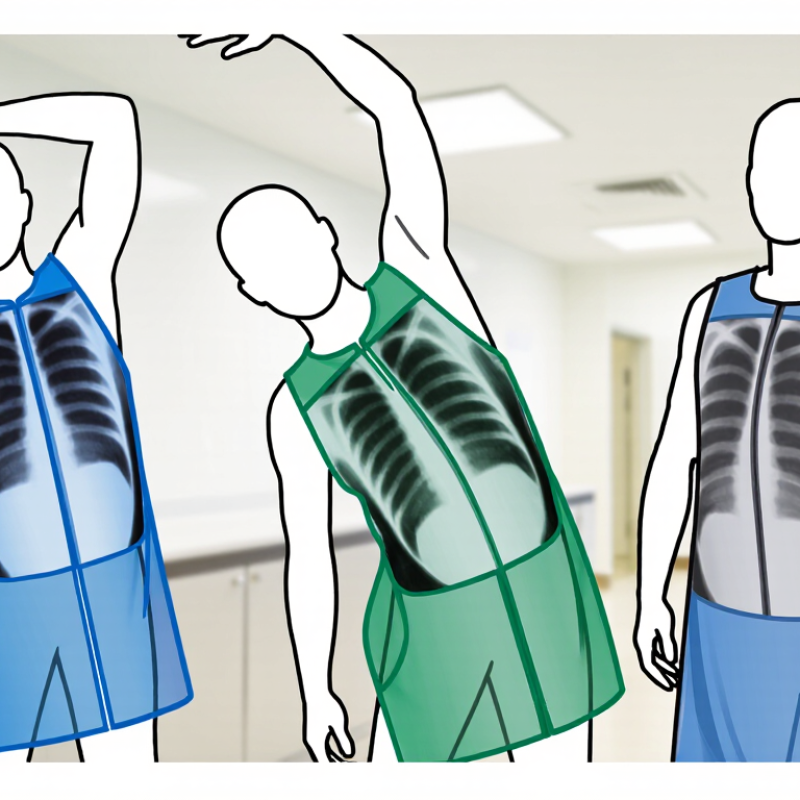
Assess Procedure Type, Workload, and Scatter Exposure Before Selection
An apron should match the work, not just the room. A short dental exposure creates a different scatter pattern from a lengthy fluoroscopy procedure. Mobile imaging also changes where staff stand and how often they move. Note the usual beam direction, the operator’s position, and which body areas face the patient. Scatter can shift with the angle.
Estimate workload using procedure frequency and time spent nearby. A few brief examinations each day may call for different protection than repeated, extended procedures. Distance matters too: stepping back during exposure can reduce scatter, but staff cannot always do so. Think about real routines, including crowded rooms and moments when positioning gets awkward. Small details count.
Compare apron coverage and attenuation ratings with the facility’s protocols and measured exposure conditions. Fit is practical protection: a poorly sized apron may leave gaps or become tiring during a long shift. Check seams and closures regularly, and follow recommended inspection procedures. No simple chart captures every room perfectly. Review the choice with a qualified radiation safety professional, especially when procedure mix or workload changes. A quick workload log can reveal patterns that memory misses.
How to Choose the Right X Ray Protection Apron? - Assess Procedure Type, Workload, and Scatter Exposure Before Selection
| Procedure or Work Setting | Typical Workload and Scatter Considerations | Apron Selection Considerations | Additional Protection and Fit |
|---|---|---|---|
| Routine diagnostic radiography | Staff are generally behind a protective barrier during exposures. Scatter exposure is usually limited when distance and barriers are used correctly. | Choose an apron only when staff must remain in the room or local policy requires one. Common nominal lead-equivalent options include 0.25, 0.35, and 0.5 mm Pb; select according to the risk assessment and applicable requirements. | Use a thyroid collar when indicated by the local protection protocol. Ensure the apron covers the torso without restricting movement. |
| Fluoroscopy and interventional procedures | Potentially frequent, prolonged exposure to patient-scattered radiation; dose depends on procedure time, beam direction, distance, and use of ceiling-suspended and table-side shielding. | Prioritize suitable coverage, secure overlap, and a comfortable design for extended wear. A wraparound or vest-and-skirt design may be useful when staff movement or exposure from different directions is expected. Consider 0.35 or 0.5 mm Pb-equivalent options based on the facility’s assessment—not as a substitute for shielding. | A thyroid collar is commonly used. Select a fit that distributes weight appropriately; use ceiling-suspended and table-side shields whenever feasible. |
| Mobile C-arm procedures | Scatter levels vary with case duration, positioning, distance from the patient, and whether staff remain near the irradiated area. | Choose coverage and lead equivalence based on expected time in the room and the local radiation-protection assessment. A wraparound style can provide more consistent coverage when staff turn or move around the patient. | Use a thyroid collar when indicated. Keep as much distance as practical and stand on the image-receptor side of the patient when appropriate to the setup. |
| Dental radiography | Operators should normally leave the room or stand behind a suitable barrier and remain outside the primary beam. Occupational scatter exposure is generally low when these practices are followed. | An apron is not a replacement for correct operator positioning or a barrier. Whether staff need an apron depends on the room arrangement and local rules. | Follow applicable local guidance for patient shielding and staff protection; requirements can differ by jurisdiction and practice setting. |
| CT procedures | Staff typically operate the scanner from outside the room during exposure. Staff who need to be in the room during scanning require a procedure-specific risk assessment. | Do not select an apron as a substitute for operating from the control area or following room-entry protocols. If in-room work is necessary, follow the facility’s radiation-protection instructions. | Use barriers and distance where available. Patient shielding practices should follow current local guidance and should not interfere with scan quality or automatic exposure control. |
| All settings: apron specification and upkeep | Workload, beam quality, staff position, distance, and shielding all affect occupational exposure. Lead equivalence alone does not describe total protection in every situation. | Check that the apron’s stated lead equivalence is supported by applicable testing or certification. Attenuation depends on X-ray beam energy and the material; a higher stated value may add weight and should be justified by the risk assessment. | Choose the correct size and coverage. Store the apron without sharp folds, inspect it at intervals set by facility policy, and arrange imaging or replacement if damage is suspected. |
Selection note: Use the facility’s radiation-protection assessment and applicable regulations to determine apron coverage and lead equivalence. An apron complements—not replaces—time, distance, barriers, and good positioning.


100% Mercury Free
All of Hapco's formulations are completely free of Mercury.

50 Year Track Record
Hapco has been in business for over 50 years!