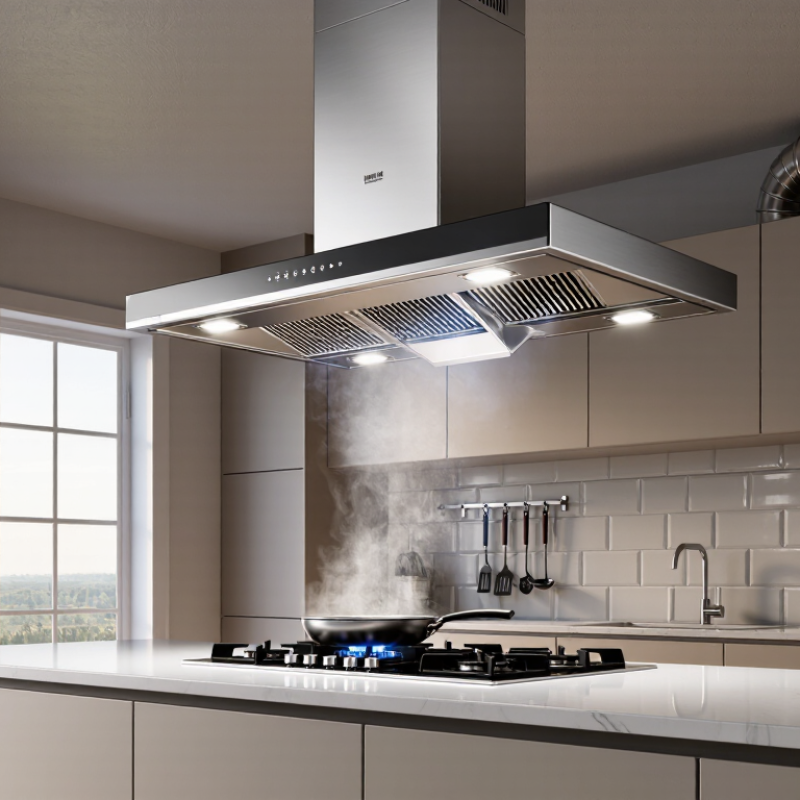
| Range Exhaust Definition | Mechanical kitchen ventilation | A range exhaust system captures smoke, grease, steam, odors, and combustion by-products near the cooking surface and removes them outdoors when configured as a ducted system. |
| Basic Operating Method | Capture, filter, and discharge | A fan creates negative pressure at the hood opening. Air and airborne contaminants are drawn through grease filters and then discharged through ductwork or recirculated after filtration in a non-ducted configuration. |
| Wall-Mounted Hood Airflow | 100 CFM per linear foot of cooking surface | This is the commonly cited HVI sizing guidance for a hood installed against a wall. For a 30-inch cooktop, the calculation is approximately 250 CFM: 2.5 feet × 100 CFM. |
| Island Hood Airflow | 150 CFM per linear foot of cooking surface | Island installations generally require more airflow because the hood is exposed on all sides and receives less assistance from an adjacent wall. For a 36-inch cooktop, the calculation is approximately 450 CFM: 3 feet × 150 CFM. |
| 30-Inch Wall Cooktop Example | Approximately 250 CFM | Recommended starting point using the wall-hood guideline: 30 inches ÷ 12 × 100 CFM = 250 CFM. Actual requirements may vary with cooking style, hood design, and local regulations. |
| 36-Inch Wall Cooktop Example | Approximately 300 CFM | Recommended starting point using the wall-hood guideline: 36 inches ÷ 12 × 100 CFM = 300 CFM. |
| 36-Inch Island Cooktop Example | Approximately 450 CFM | Recommended starting point using the island-hood guideline: 36 inches ÷ 12 × 150 CFM = 450 CFM. |
| High-Heat Cooking | Use a higher airflow allowance when appropriate | Frequent grilling, wok cooking, searing, frying, or use of multiple high-output burners can require more airflow than the basic linear-foot calculation. |
| Hood Capture Area | Hood should cover the cooking surface | A hood that is at least as wide as the range generally provides better capture. Island hoods may need additional depth or width because cross-drafts can carry contaminants beyond the canopy. |
| Typical Mounting Height | Approximately 24–30 inches above an electric cooktop; approximately 30–36 inches above a gas cooktop | These are common installation ranges, not universal requirements. The installation manual and local code should control the final mounting height. |
| Grease Filter Function | Metal mesh or baffle filtration | Filters remove grease particles from the exhaust stream and help protect the fan and ductwork. Filters must be correctly installed and cleaned regularly. |
| Ducted Exhaust | Discharges air outdoors | Ducted systems generally provide the most effective removal of heat, moisture, smoke, and odors. The duct route should be as short and straight as practical. |
| Recirculating Exhaust | Filters and returns air indoors | Non-ducted systems can reduce grease and some odors but do not remove heat, moisture, or combustion gases from the room. Carbon filters may require periodic replacement. |
| Duct Efficiency | Rigid, smooth, correctly sized ductwork preferred | Long runs, sharp bends, undersized ducts, flexible ducting, and restrictive terminations increase resistance and can reduce delivered airflow and increase noise. |
| Make-Up Air Consideration | Evaluate at higher exhaust rates | Strong exhaust can depressurize a tightly sealed home. Depending on local requirements and the airflow level, a dedicated make-up air system may be needed to replace exhausted air. |
| Noise and Performance | Higher airflow usually increases sound and power demand | Fan noise depends on airflow, motor design, duct resistance, and installation quality. Selecting a hood with more capacity than necessary does not always improve capture if the duct system is restrictive. |
| Final Sizing Check | Use the greater applicable requirement | Confirm the airflow calculation against the hood installation instructions, appliance output, duct design, make-up air provisions, and local building or mechanical codes before installation. |