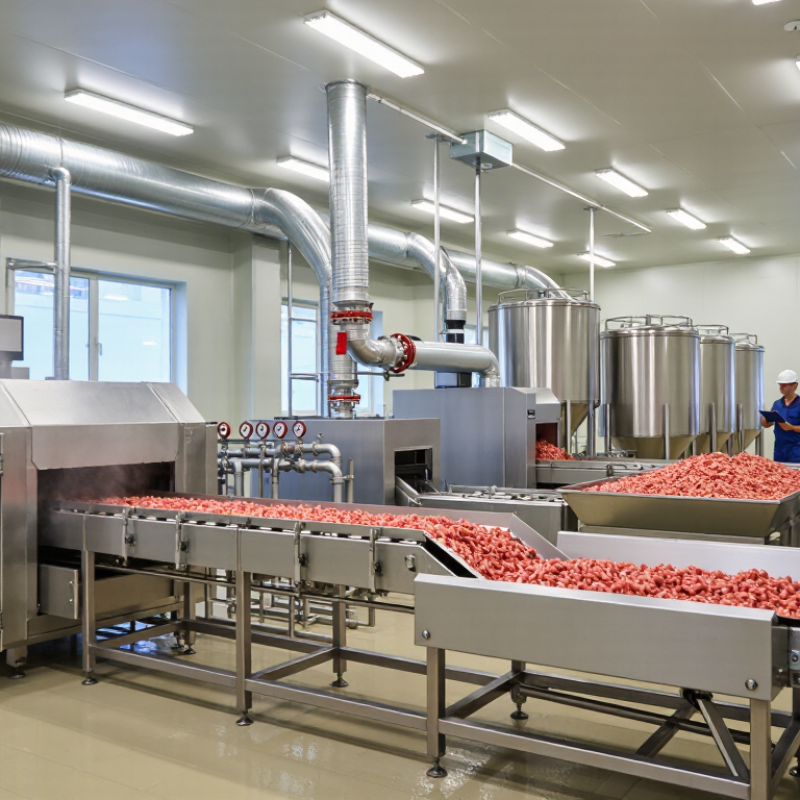
| 1 | Continuous Cooker | Heats raw fish to coagulate proteins, release bound water and oil, and prepare the material for pressing. | Common product temperatures are approximately 85–95°C; residence time is often about 10–20 minutes, depending on raw material and design. | Heating uniformity, residence-time control, steam consumption, and protection against overheating. | Continuous operation, good heat transfer, and improved separation in the downstream press. | Excessive temperature or residence time can reduce protein quality and increase energy use. |
| 2 | Twin-Screw Press | Separates cooked fish into a solid press cake and a liquid fraction containing water, dissolved solids, and oil. | Press-cake moisture commonly leaves the press at roughly 45–55%, although results vary with species and raw-material condition. | Throughput, press-cake moisture, oil carryover, screw speed, and compression adjustment. | Efficient continuous dewatering with adjustable pressure and comparatively compact installation. | Poor cooking or unstable feed conditions can cause fluctuating moisture and lower separation efficiency. |
| 3 | Decanter Centrifuge | Clarifies press liquor by separating suspended solids from water and fish oil before oil recovery or evaporation. | Typical bowl speeds are approximately 2,500–4,000 rpm; actual settings depend on bowl diameter, feed rate, and product properties. | Solids capture, feed capacity, differential speed, vibration level, and cleanability. | Compact footprint, continuous clarification, and effective handling of variable liquid-solid mixtures. | Higher electrical demand and maintenance requirements than simple settling or screening systems. |
| 4 | Indirect Steam Dryer | Removes moisture from press cake using heated surfaces, while limiting direct contact between the product and combustion gases. | Finished fish meal is commonly dried to approximately 6–10% moisture; product temperature is controlled to protect quality. | Evaporation capacity, steam pressure, product temperature, final moisture, and residence time. | Good product hygiene, reduced risk of combustion-gas contamination, and accurate moisture control. | Steam demand can be significant, and fouling may reduce heat-transfer performance. |
| 5 | Direct Hot-Air Dryer | Dries fish solids through direct contact with heated air or combustion gases, usually in a rotary or pneumatic drying system. | Drying-air temperatures may range from about 120–250°C, while the actual product temperature should be carefully monitored. | Thermal efficiency, exhaust-gas quality, residence time, final moisture, and odor-control performance. | High evaporation capacity and suitability for plants with available hot gas or limited steam supply. | Greater risk of oxidation, odor emissions, and contamination if air quality and temperature are not controlled. |
| 6 | Meal Mill or Hammer Mill | Reduces dried fish cake into a consistent meal suitable for storage, handling, and final product blending. | Common finished particle sizes are approximately 0.5–3.0 mm, selected according to product specifications and end use. | Throughput, screen size, temperature rise, power consumption, and particle-size distribution. | Flexible particle-size control and effective size reduction after drying. | Dust generation, wear of screens and hammers, and possible heat buildup during extended operation. |
| 7 | Cyclone, Scrubber and Odor-Control System | Captures dust and helps treat process air, vapors, and odor released during cooking, drying, and meal handling. | Selection is based on airflow, particulate loading, gas temperature, odor concentration, and applicable emission limits. | Capture efficiency, pressure drop, airflow stability, corrosion resistance, and wastewater requirements. | Improves workplace air quality, supports environmental compliance, and reduces product loss as airborne dust. | Adds fan power, maintenance, and—when wet scrubbing is used—water and wastewater management needs. |