
Buying Track Chain Link for an excavator or bulldozer is not just a price comparison. A low quote can hide mismatched pitch, unclear component coverage, or limited inspection records. Those details matter. A small dimensional difference can cause fitting problems, uneven wear, or costly downtime. Global purchasing adds other variables, including supplier communication, packaging, delivery schedules, and after-sales support.
This guide presents seven practical checks to make supplier comparisons more reliable. Buyers should confirm the machine model, chain specifications, link count, and compatibility before requesting a final quotation. Ask how the supplier controls material quality and heat treatment, and request relevant inspection documents where available. Clear photos and written specifications can help, but they do not replace measurement or technical confirmation. That distinction is easy to overlook.
Price still matters. So does the cost of a poor fit. Compare warranty terms, production lead times, packing details, and the process for resolving quality concerns. A supplier’s confident claim is not proof by itself; look for specific, consistent answers. Even careful buyers may discover that one requirement was never written down. Reviewing the details before placing an order can reduce avoidable surprises and support a more dependable purchasing decision.
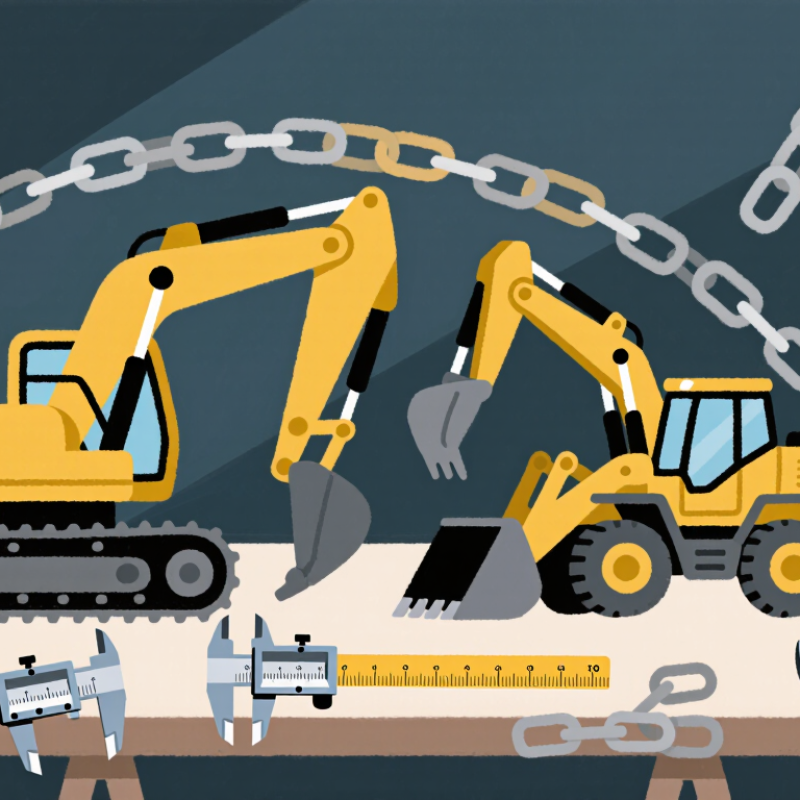
Before requesting a track chain, identify the machine by its undercarriage, not by appearance alone. Record the installed chain’s pitch, link count, and shoe width. Pitch is the distance between matching pin centers, measured in a straight line. If wear makes one gap difficult to judge, measure several links and divide by the number of intervals. A tape measure can help, but calipers may give a clearer reading. Check both sides; past repairs can leave different components installed.
Count every link around the full chain, including the master link if present. Do not estimate from one visible section. A missed link can affect fit and adjustment range. Measure shoe width across the plate, not across bolt heads or worn edges. Note grouser height and shoe shape too, since width alone does not describe ground contact. Keep clear photos with the measurements. Useful.
Compare the figures with service records or a parts diagram for the machine’s exact configuration. Serial ranges and earlier repairs may leave mixed components. It happens. If pitch or count remains uncertain, ask the supplier to verify photos and dimensions before shipment. Avoid ordering by model name alone. Recheck the count; handwritten notes are easy to misread, especially when the chain is muddy or unevenly tensioned.

Track-chain fit begins with the OEM drawing, not a supplier’s “standard size.” Confirm pin diameter, bushing inside diameter, length, shoulder dimensions, and specified tolerances. ISO 286-1:2010 explains how limits and fits depend on nominal size and tolerance grade; it does not set one universal clearance for every chain. Check the drawing revision and units before comparing quotes. Small errors matter.
Measure the pin at three positions along its length and in two perpendicular directions at each position. That gives six readings and helps reveal taper or ovality. Measure the bushing bore at both ends and through its center. Use calibrated micrometers and bore gauges, then record the actual readings—not just “pass.” Compare each value with the OEM limits, and calculate the pin-to-bore clearance using the specified method. A single midpoint reading can hide uneven wear or machining variation.
Ask suppliers for inspection records tied to the quoted part number and drawing revision. Photos of a caliper display are weak evidence; the instrument, calibration status, and measurement locations should be clear. Check how parts were measured and at what temperature, especially when comparing samples from different factories. I have seen buyers focus on nominal diameter and overlook bushing length. That detail can disrupt alignment even when the main diameter looks correct. Verify both dimensions before approving a production sample.
Hardness checks can reveal inconsistent heat treatment before track links enter service. ISO 6508-1:2023 specifies Rockwell testing procedures and force levels. Its standard preliminary force is 98.07 N; total forces include 588.4 N, 980.7 N, and 1,471 N. The correct scale depends on the material and expected hardness. For example, HRC uses a diamond indenter and a 1,471 N total force. Record the scale, readings, test location, and batch number—not just “passed.” Small details matter.
Chain links are curved, so a test directly on an uneven surface may mislead. Ask suppliers for results from a properly prepared flat area or a representative coupon processed with the same batch. Check that the surface is clean, smooth, and thick enough for the selected method. Take several readings across sampled links; one reading can flatter an inconsistent batch. ISO 18265:2013 provides hardness-conversion tables, but converted values are estimates, not replacements for direct testing. That distinction is easy to miss.
When results sit near a purchase limit, request the original scale readings and review the test setup with a qualified laboratory. A certificate helps, but it cannot fix poor sampling.
For track chain links, a supplier’s quality system matters as much as the quoted price. Ask how ISO 9001 procedures are used on the production floor, not just whether a certificate exists. Request recent inspection records for dimensions, material condition, and heat treatment. A reliable supplier should explain who checks each step and what happens when a part fails. Paperwork can look neat. The process behind it matters more.
Tips: Check the certificate’s scope and validity. Ask for a sample inspection report. Confirm that lot numbers connect finished links to material and production records. Compare the report with the chain-link specifications you actually need. If answers are vague, pause and ask for a real example.
Batch traceability helps buyers investigate defects without treating every shipment as identical. Each batch should have a clear identifier on packaging and linked records for raw material, production date, inspection results, and release approval. Test this before placing a large order: choose one lot number and ask the supplier to trace it backward. The response should be specific and reasonably quick. Still, traceability is not proof that every link is perfect; sampling and independent checks may reveal gaps. A small trial order can expose weak recordkeeping, though it may not show how the system performs during peak production.
| Buying Tip | What to Check | Useful Batch Records | Practical Buyer Action |
|---|---|---|---|
| 1. Confirm the quality system’s scope | Check that the supplier’s ISO 9001 certificate is current and that its stated scope covers the relevant manufacturing activities. ISO 9001 certification alone does not certify a particular chain link or guarantee its performance. | Certificate details, audit status, applicable procedures, and records linked to the production site and product type. | Verify certificate validity with the issuing certification body or its official directory, and ask for the certificate scope and site address. |
| 2. Define the link and application requirements | Specify chain pitch, link dimensions, intended machine or undercarriage application, operating conditions, and any required drawings or acceptance criteria. | Approved drawing revision, product specification, order reference, and inspection criteria associated with the lot. | Obtain written confirmation that the quotation and order reference the same drawing revision and requirements. |
| 3. Trace material to the finished batch | Ask how incoming steel or other specified material is identified and connected to work-in-process and finished chain links. | Material grade or specification, supplier lot or heat number where available, receiving inspection, and production lot identifier. | Request a redacted sample traceability record showing how one finished lot can be linked back to its material records. |
| 4. Review process controls and change management | Understand how forming, heat treatment, machining, and other applicable processes are controlled, and how changes to materials, processes, or production sites are reviewed. | Process instructions, equipment or furnace records where relevant, inspection checkpoints, and approved change records. | Agree that significant changes affecting fit, function, or agreed requirements must be communicated before shipment. |
| 5. Check inspection evidence against agreed criteria | Review the inspection plan and confirm that measured characteristics match the drawing, purchase order, and applicable technical requirements. | Lot identification, inspection date, measured results, acceptance status, and identification of the responsible inspection function. | Request a lot-specific inspection report; do not rely on a generic certificate that is not linked to the shipment. |
| 6. Verify nonconformity and corrective-action handling | Ask how suspect or nonconforming product is identified, segregated, reviewed, and prevented from being shipped without authorized disposition. | Nonconformity reference, affected lot or quantity, disposition, corrective-action record, and effectiveness review when applicable. | Include a written process for reporting defects, preserving evidence, and agreeing on containment and resolution. |
| 7. Confirm shipment identification and record retrieval | Ensure packages and shipping documents identify the product and production lot consistently, and confirm that supporting records can be retrieved after delivery. | Package or lot code, product description, quantity, packing list, inspection report, and record-retention details. | Agree on the lot-code format, required documents, record-retention period, and response process for traceability requests. |
Buyer note: ISO 9001 requires a documented quality management system and appropriate control of documented information; specific batch-traceability details depend on the product, applicable requirements, and agreed customer controls.
When sourcing track chain, compare FOB, CIF, and DDP using the same chain grade, pitch, quantity, and delivery address. Ask suppliers to state the named port or place, quotation currency, and validity period. Small differences matter. A heavier crate can change freight charges, while unclear packaging dimensions make quotes hard to compare.
With FOB, the seller clears the goods for export and loads them aboard at the named port. The buyer arranges and pays for main carriage, insurance, and import costs.
Under CIF, the seller pays freight and minimum insurance to the destination port, but risk transfers when the goods are loaded at origin. That distinction is easy to miss. Compare the insurance cover and destination charges, not just the CIF price.
DDP includes delivery to the named destination and seller responsibility for import clearance, duties, and taxes. The buyer generally handles unloading. Confirm the seller can manage import requirements in your destination, and request a line-by-line landed-cost breakdown. Check whether port handling, customs-related fees, inland trucking, and unloading are included or excluded. These details vary by route and shipment. A low quote may still leave gaps, so verify each cost before comparing offers.


All of Hapco's formulations are completely free of Mercury.

Hapco has been in business for over 50 years!

*NOTICE* Hapco will be will be closed on Monday, May 26th, in observance of Memorial Day. |
| Cookie | Duration | Description |
|---|---|---|
| cookielawinfo-checkbox-analytics | 11 months | This cookie is set by GDPR Cookie Consent plugin. The cookie is used to store the user consent for the cookies in the category "Analytics". |
| cookielawinfo-checkbox-functional | 11 months | The cookie is set by GDPR cookie consent to record the user consent for the cookies in the category "Functional". |
| cookielawinfo-checkbox-necessary | 11 months | This cookie is set by GDPR Cookie Consent plugin. The cookies is used to store the user consent for the cookies in the category "Necessary". |
| cookielawinfo-checkbox-others | 11 months | This cookie is set by GDPR Cookie Consent plugin. The cookie is used to store the user consent for the cookies in the category "Other. |
| cookielawinfo-checkbox-performance | 11 months | This cookie is set by GDPR Cookie Consent plugin. The cookie is used to store the user consent for the cookies in the category "Performance". |
| viewed_cookie_policy | 11 months | The cookie is set by the GDPR Cookie Consent plugin and is used to store whether or not user has consented to the use of cookies. It does not store any personal data. |