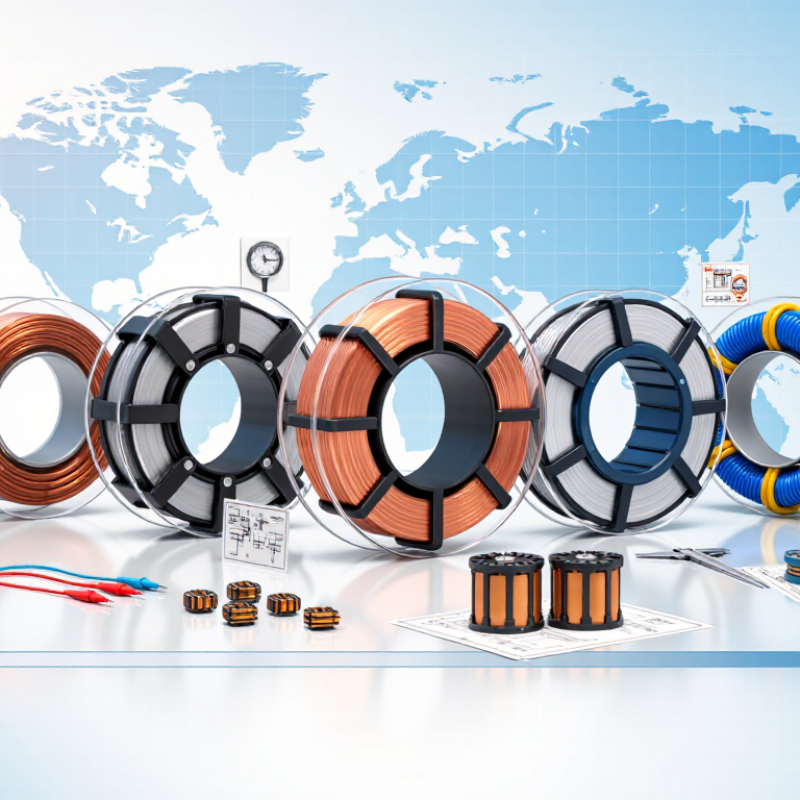
Buying Transformer Winding components or finished units across borders requires more than comparing quoted prices. Buyers need to match electrical requirements with insulation class, conductor material, turns ratio, voltage, load, cooling method, and operating conditions. Small differences can affect heat rise, efficiency, and service life. Details matter. A copper winding and an aluminum winding may look similar in a product photo, but they are not interchangeable without engineering review. Ask for drawings, tolerances, and test records before approving a sample. These checks can reveal gaps early, though documents alone cannot prove consistent production.
An informed global buyer also checks supplier experience, traceability, inspection methods, packaging, and communication. Ask how winding tension is controlled, how insulation is protected from moisture, and whether routine tests match the agreed specification. Practical evidence helps: a dated test report, labeled coil identification, and clear packing photos. Request references or a sample when the order size or risk justifies it. Confirm delivery terms, lead time, warranty scope, and responsibility for damage claims before production starts. Requirements differ by transformer type and destination. Verify applicable standards and certification needs with qualified engineers and relevant authorities; do not rely on a sales sheet alone. A supplier may answer most questions well and still miss one important detail. It happens. Treat that as a reason to clarify, not accuse. The seven tips below offer a practical way to compare offers, assess manufacturing controls, and identify unanswered questions. They are not a substitute for technical review. Good procurement leaves room for one more question.
A transformer winding must match the destination grid, not just the voltage on a purchase sheet. At the same voltage, 50 Hz operation generally needs more magnetic capacity than 60 Hz operation to avoid excessive core flux. A unit designed only for 60 Hz may overheat or saturate if connected to 50 Hz. Check the nameplate frequency and confirm any dual-frequency rating in the technical documents. Small details matter.
Tip: Share the actual voltage, frequency, and rated load before requesting a winding design. Rated load determines winding current, which guides conductor size and thermal design. For example, a 500 kVA unit draws different current at different voltages, even when its capacity stays unchanged. Ask the supplier to state the expected temperature rise and cooling method, too. These figures help buyers compare proposals on equal terms.
Consider the real operating pattern, not only the average load. A motor may draw a brief starting current, while harmonics from electronic equipment can increase winding losses. Provide those details when they apply. I have seen specifications omit this information; it can make an otherwise suitable design harder to verify. Request drawings or a rating plate draft for review before production, and check that frequency, voltage, kVA, and winding connections match the order.

At 20°C, annealed copper defines the IACS conductivity reference at 100%; common electrical-grade aluminum is about 61%. For a conductor of equal length and resistance, aluminum may need roughly 1.6 times the cross-sectional area, assuming comparable material conditions. It weighs much less, but its larger dimensions can use more winding-window space. A compact transformer may therefore favor copper, while weight-sensitive designs may benefit from aluminum.
The percentage is useful, but incomplete. Resistance changes as winding temperature rises, and alloy, conductor shape, cooling, and joint quality also affect performance. Aluminum surfaces form an oxide layer, so connection design and installation procedures deserve careful review. Small details matter. Ask suppliers for conductor dimensions, material specifications, temperature-rise data, and joint requirements. Compare these against the transformer’s drawings and expected load, not just the IACS figure. A simple conductivity ratio can make aluminum look like a direct substitute; in practice, the design may need adjustments, and those adjustments should be checked rather than assumed.
For global buyers, winding checks should begin with rated voltage, frequency, and current—not a supplier’s headline efficiency. Verify turns against the voltage ratio and core design, then confirm that the conductor’s net copper area carries the rated current. Insulation does not conduct current. For stranded wire, use the actual copper area, not the bundle’s outside diameter.
Calculate current density as rated current divided by net conductor area, in A/mm². Then review it alongside cooling method, insulation class, duty cycle, and allowable temperature rise. A higher density can reduce copper use, but it also raises resistive loss and heat. Check the winding’s resistance and load-loss figures against the declared rating. Small differences matter.
The U.S. Department of Energy’s 2024 distribution-transformer standards analysis projects 10.8 quadrillion Btu in cumulative energy savings over 30 years. That system-level estimate is not a winding-design limit; it shows why loss figures deserve scrutiny. Ask for a design sheet listing turns, conductor dimensions, rated current, and calculated current density. Check the figures yourself. A neat spreadsheet can still hide an assumption about cooling or usable copper area. I would treat unexplained assumptions as a reason to request revised calculations, not as proof of poor workmanship. Source: U.S. DOE, Distribution Transformer Energy Conservation Standards Technical Support Document, 2024.
For global transformer buyers, insulation class is a design limit, not a promise of continuous operating temperature. IEC 60085:2007 assigns Class F a thermal class of 155°C and Class H a thermal class of 180°C. These figures help compare insulation systems, but they do not replace checking the transformer’s specified temperature rise, ambient conditions, and expected loading. Class H is not automatically the safer or more economical choice.
Ask suppliers to state the insulation class and the applicable winding temperature-rise limits on the technical datasheet. IEC 60076-11:2018 sets requirements for dry-type transformers, including temperature-rise limits; confirm which requirements apply to your transformer type. Then check the cooling method, enclosure ventilation, altitude, and overload profile. A unit installed in a hot, dusty room may face a very different thermal reality from one tested under controlled conditions. Small details matter.
Request test evidence and clarify how hot-spot temperature is assessed. The standards give a sound basis, but specifications can still be incomplete. I have seen buyers focus on the class letter and overlook actual operating conditions. That is an easy mistake. Compare the full thermal design, not just “F” against “H.”
| # | Specification Dimension | Practical Data or Options | What Buyers Should Confirm |
|---|---|---|---|
| 1 | Insulation thermal class | IEC 60085 designates Class F as 155°C and Class H as 180°C. | State the required thermal class and ask whether it applies to the complete insulation system. A thermal class is not, by itself, a permitted ambient temperature or winding-temperature-rise limit. |
| 2 | Winding conductor material | Copper and aluminium are both used in transformer windings. Copper has higher electrical conductivity by volume; aluminium generally requires a larger conductor cross-section for comparable resistance. | Specify the material, conductor dimensions, connection method and any project-specific limits. Compare designs on the required electrical and thermal performance, not material name alone. |
| 3 | Rated voltage and frequency | Common supply frequencies include 50 Hz and 60 Hz. For a given winding and core, magnetic flux is related to the applied voltage-to-frequency ratio (V/f). | Provide rated primary and secondary voltages, frequency, tap range and connection arrangement. Confirm that the design is suitable for the stated V/f and operating conditions. |
| 4 | Conductor size and winding current | Required conductor area depends on current, material, winding geometry, cooling and allowable temperature rise; there is no single current-density value suitable for every transformer. | Request the rated current and winding-loss information for each winding, and have conductor dimensions checked against the specified duty and cooling method. |
| 5 | Insulation materials and construction | Winding insulation may use combinations of conductor covering, turn insulation, layer insulation, barriers and spacers. The materials and arrangement depend on the design. | Ask for the insulation-system thermal class and relevant construction details. Verify that material choices and clearances meet the applicable electrical, thermal and mechanical requirements. |
| 6 | Cooling, duty and temperature rise | Temperature performance depends on losses, loading profile, cooling arrangement, ambient conditions and enclosure or installation conditions. | Specify continuous or cyclic duty, overload requirements, cooling method, maximum ambient temperature and installation altitude where relevant. Confirm the guaranteed temperature-rise limits separately from the insulation class. |
| 7 | Inspection and test documentation | IEC 60076-1 includes general requirements and routine-test provisions for power transformers, including checks such as winding resistance and voltage ratio. | Agree on the applicable standards and test scope before ordering. Request the routine-test report and confirm that nameplate ratings, tap positions and connection details match the purchase specification. |
Buyer note: Specify the complete transformer duty and applicable standards in the enquiry. Final winding design, insulation coordination and temperature performance should be verified by the manufacturer for the stated application.
7 Transformer Winding Tips for Global Buyers
Verify Temperature Rise and Test Requirements Under IEC 60076
Temperature-rise limits are not interchangeable across transformer designs. IEC 60076-2:2011 gives commonly applied limits for liquid-immersed transformers: 60 K for top-liquid rise and 65 K for average winding rise under specified conditions. These are rises above the cooling medium, not absolute operating temperatures. Confirm the applicable insulation system, cooling method, and contract specification before comparing offers. Dry-type units follow a different part of the IEC 60076 series.
Ask for the temperature-rise test report, not just a pass statement. It should identify rated power, cooling arrangement, ambient conditions, measurement method, and final readings. Winding-average temperature is typically determined by resistance measurement; top-liquid temperature is measured with a thermometer. Check that the report names the tested unit and matches the proposed design. Small differences matter.
A tidy table can still hide a weak test plan. Confirm whether the test was performed on the offered transformer or a representative unit, and ask how deviations were handled. Also align routine and type-test requirements with IEC 60076-1 and IEC 60076-2 in the purchase specification. This reduces disputes at inspection. Not every tender defines “temperature rise” clearly, and that gap deserves attention before shipment.


All of Hapco's formulations are completely free of Mercury.

Hapco has been in business for over 50 years!
*NOTICE* Hapco will be will be closed on Monday, May 26th, in observance of Memorial Day. |
| Cookie | Duration | Description |
|---|---|---|
| cookielawinfo-checkbox-analytics | 11 months | This cookie is set by GDPR Cookie Consent plugin. The cookie is used to store the user consent for the cookies in the category "Analytics". |
| cookielawinfo-checkbox-functional | 11 months | The cookie is set by GDPR cookie consent to record the user consent for the cookies in the category "Functional". |
| cookielawinfo-checkbox-necessary | 11 months | This cookie is set by GDPR Cookie Consent plugin. The cookies is used to store the user consent for the cookies in the category "Necessary". |
| cookielawinfo-checkbox-others | 11 months | This cookie is set by GDPR Cookie Consent plugin. The cookie is used to store the user consent for the cookies in the category "Other. |
| cookielawinfo-checkbox-performance | 11 months | This cookie is set by GDPR Cookie Consent plugin. The cookie is used to store the user consent for the cookies in the category "Performance". |
| viewed_cookie_policy | 11 months | The cookie is set by the GDPR Cookie Consent plugin and is used to store whether or not user has consented to the use of cookies. It does not store any personal data. |